
How to Use ChatGPT for SEO Keyword Research (Without Getting Bad Data)
ChatGPT can generate 100 keyword ideas in 30 seconds. But here's the problem: at least half of them might be completely made up.
AI tools like ChatGPT excel at brainstorming and pattern recognition, but they don't have access to real search data. They can't tell you actual search volumes, competition levels, or whether anyone is actually searching for the terms they suggest. Relying on AI alone for keyword research is like navigating with a map that might be fiction.
Yet dismissing AI entirely means missing out on its genuine strengths: uncovering angles you hadn't considered, generating variations at scale, and organizing keywords by intent faster than any human could.
The solution? A hybrid workflow that combines AI creativity with real SEO data validation.
In this guide, you'll learn a step-by-step process for using ChatGPT alongside traditional SEO tools to discover keywords you'd never find manually, then validate them with actual search metrics. We'll cover crafting effective prompts, avoiding AI pitfalls, clustering keywords by intent, and integrating AI-discovered terms into your keyword strategy.
AI seo tools are powerful. But human judgment plus AI is unbeatable.
Why Use AI in Keyword Research?
Before diving into the workflow, let's clarify what AI does well and where it falls short. Understanding these boundaries helps you use ChatGPT effectively without being misled.
What AI Does Well
1. Brainstorming at scale
Ask ChatGPT for 50 keyword ideas around a topic, and you'll get them in seconds. This seo automation saves hours compared to manual brainstorming.
2. Finding angles and variations
AI excels at lateral thinking. It can suggest synonyms, related concepts, question formats, and long-tail variations you might not have considered. This is particularly valuable for competitor keyword analysis, where you need to find gaps.
3. Organizing and clustering
ChatGPT can group keywords by intent, topic, or funnel stage faster than you can manually sort a spreadsheet. Topic modeling and semantic clustering are natural strengths.
4. Writing prompt-based content ideas
Once you have validated keywords, AI can help brainstorm content angles, titles, and outlines, a useful extension of the research process.
Where AI Falls Short
1. Actual search data
ChatGPT doesn't have access to Google's search volume data. Any numbers it provides are estimates at best, fabrications at worst. Never trust AI-generated volume or difficulty metrics.
2. Current trends
AI training data has a cutoff date. It won't know about trending topics, algorithm updates, or seasonal shifts happening right now. Market trend analysis requires real-time data.
3. Your specific niche
AI knows general patterns but doesn't understand your unique industry jargon, customer language, or competitive environment. Human expertise fills this gap.
4. Validation
AI can suggest keywords confidently, but it can't verify whether those keywords actually get searched, have reasonable competition, or match user intent. That's your job.
The Hybrid Approach
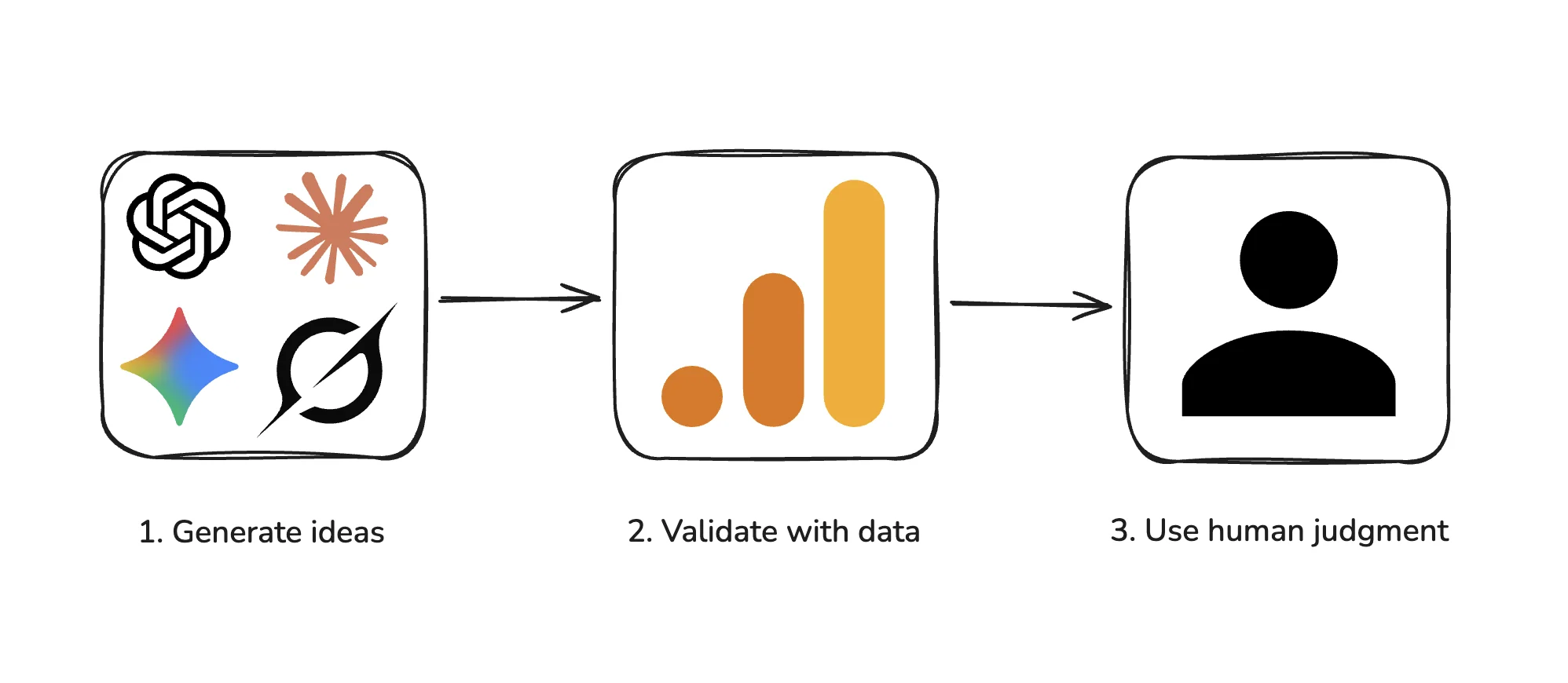
The best ai keyword research workflow treats AI as a brainstorming partner, not a data source:
- Use AI to generate ideas, variations, and clusters quickly
- Use SEO tools to validate suggestions with real data (volume, difficulty, CPC)
- Use human judgment to filter for relevance, intent match, and strategic fit
This combination produces keyword lists that are both creative and data-backed.
Overview of Tools You'll Need
This workflow combines free AI chatbots with keyword research platforms. Here's what to have ready:
AI Tools (For Idea Generation)
ChatGPT (Free or Plus)
- Best for brainstorming and clustering
- Use reasoning mode for more nuanced understanding of search intent
- Free tier works fine for keyword generation
Claude
- Alternative to ChatGPT with strong reasoning capabilities
- Good for complex prompt engineering tasks
- Useful for organizing large keyword lists
Google Gemini
- Connected to Google's ecosystem
- Can sometimes provide fresher information
- Good for local and regional keyword variations
SEO Tools (For Validation)
Google Keyword Planner (Free)
- Provides search volume ranges and competition indicators
- Requires a Google Ads account (no spending needed)
- Best for initial validation of AI suggestions
- See our complete guide to free keyword research tools for detailed setup instructions
BrightKeyword
- AI-powered keyword discovery with real search data
- Automatically clusters keywords by intent
- Provides exact volumes, CPC, and 12-month trends
- Great for expanding AI discoveries into full clusters
Google Search Console (Free)
- Shows keywords you already rank for
- Validates whether suggested terms get real impressions
- Essential for identifying quick-win opportunities
Google Trends (Free)
- Confirms whether terms are growing or declining
- Useful for seasonal and trending keyword validation
- Compares relative interest between variations
Optional: Spreadsheet
Google Sheets or Excel for organizing your keyword research. You'll collect AI suggestions, add validation data, and track which terms make the cut.
Step 1: Generate Seed Keywords with ChatGPT
Start by using AI to brainstorm a broad list of keyword ideas. The goal at this stage is quantity and creativity, not precision.
Crafting Effective Prompts
The quality of AI output depends heavily on your prompts. Vague prompts produce generic results. Specific prompts with context yield better suggestions.
Bad prompt:
Give me keyword ideas for SEO.
Better prompt:
I run a B2B SaaS company that sells project management software to marketing agencies.
Generate 30 keyword ideas that marketing agency owners might search for when looking
for project management solutions. Include a mix of informational queries (how-to, what is),
commercial queries (best, top, comparison), and problem-based queries (challenges they face).
Prompt Templates That Work
Here are proven prompts for different keyword research needs:
For discovering topic variations:
I'm researching keywords for [your topic]. Generate 25 keyword ideas including:
- 5 "how to" questions
- 5 "what is" questions
- 5 comparison queries (X vs Y, best X)
- 5 problem-based queries (challenges, issues, solutions)
- 5 long-tail specific queries

Format each as a simple keyword phrase, not a sentence.
For finding industry jargon:
What specific terminology, jargon, or acronyms do [target audience] use when discussing [topic]?
List 20 terms that might not appear in mainstream keyword tools but
are commonly used by practitioners.
For expanding a seed keyword:
I have a primary keyword: "[your keyword]"

Generate 20 related keywords including:
- Synonyms and alternate phrasings
- Questions people ask about this topic
- Long-tail variations with 4+ words
- Related subtopics worth covering

Focus on terms a [target audience] would actually search.
For competitor angle discovery:
If someone is comparing [your product category] options, what specific features,
criteria, or concerns would they search for? List 15 comparison-related keywords they might use.
Refining AI Output
After generating initial ideas, ask ChatGPT to refine:
Review this keyword list and:
1. Remove any that seem too broad or generic
2. Flag any that might have very low search volume
3. Suggest 5 more specific alternatives for the generic ones
4. Group the remaining keywords by search intent (informational, commercial, transactional)
This prompt engineering approach produces cleaner output than accepting the first response.
Collecting Your Initial List
At this stage, you should have 50-100 keyword ideas from AI. Don't worry about quality yet. Collect everything in a spreadsheet with columns for:
- Keyword
- Source (ChatGPT, Claude, etc.)
- Estimated intent (informational, commercial, transactional)
- Notes
Next, we'll validate these with real data.
Step 2: Validate Keywords with SEO Tools
Now comes the critical step most AI-only workflows skip: checking whether anyone actually searches for these terms.
Taking AI Keywords to Google Keyword Planner
- Go to Google Keyword Planner
- Select "Discover new keywords"
- Enter your AI-generated keywords (you can paste multiple at once)
- Review the results
What to look for:
- Search volume: Does the keyword have any searches? GKP shows ranges (10-100, 100-1K, 1K-10K, etc.)
- Competition: Low, Medium, or High (this is for ads, but correlates loosely with SEO difficulty)
- Suggested bid: Higher CPC often indicates commercial intent and value
Red flags:
- Zero volume shown: The term might not be searched as phrased
- No data available: GKP doesn't recognize the term, may need rephrasing
Filtering Out Low-Value Keywords
After GKP validation, remove keywords that:
- Show no search volume: If GKP can't find it, likely no one searches for it
- Are too competitive for your authority: High competition terms need a realistic path to ranking
- Don't match your business: Even good keywords are worthless if they attract the wrong audience
Enriching with More Detailed Data
Google Keyword Planner provides ranges, not exact numbers. For more precise data, use a dedicated keyword tool.
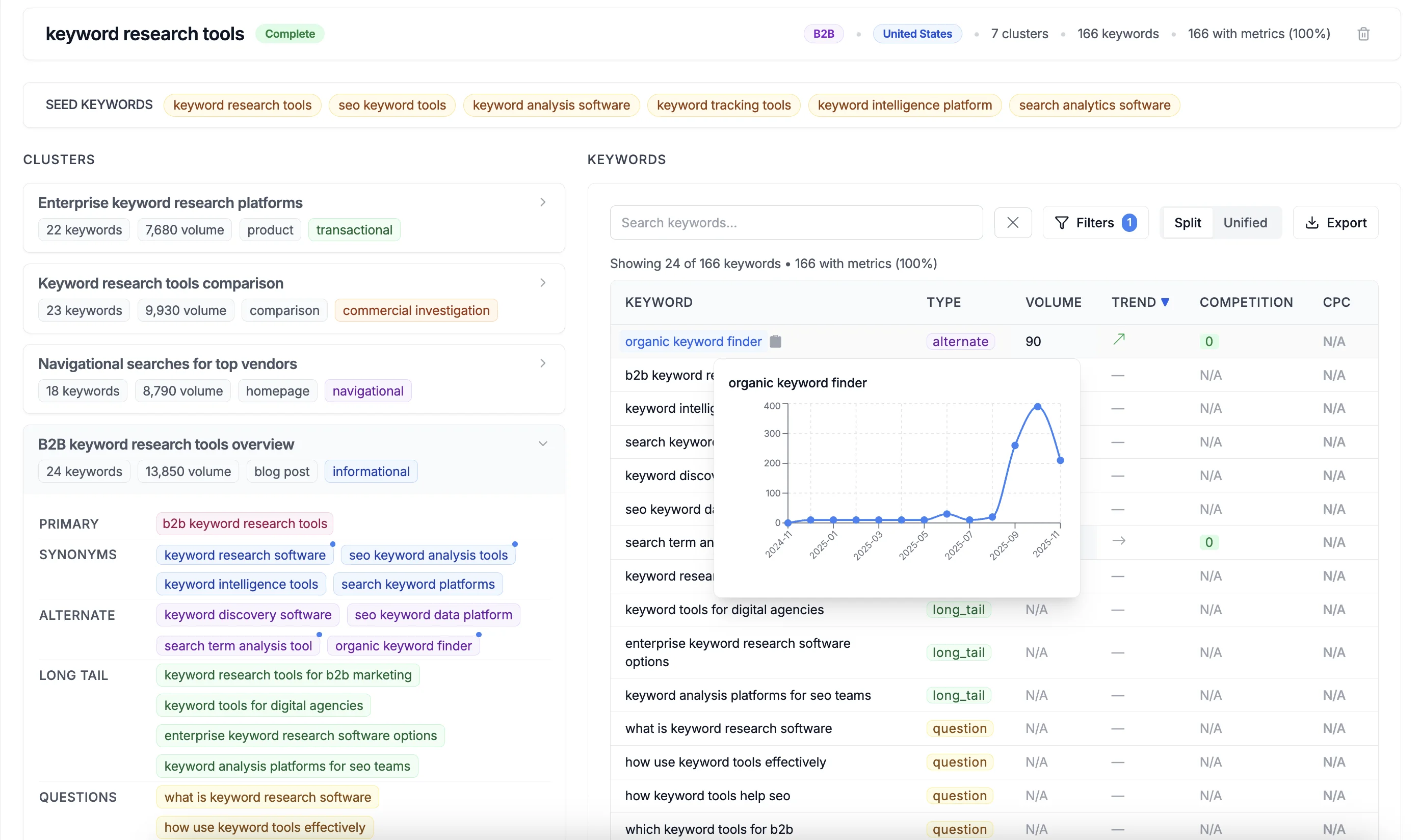
With BrightKeyword, you can:
- Enter your validated keywords or topic
- Get exact monthly search volumes (not ranges)
- See competition levels based on ranking difficulty
- View 12-month trend data to spot seasonal patterns
- Discover related keywords you might have missed
The combination of AI brainstorming plus real data validation gives you keyword lists that are both creative and grounded in reality.
Cross-Checking with Google Trends
For keywords that pass initial validation, confirm they're not declining:
- Go to Google Trends
- Enter your keyword
- Check the trend line over the past 12 months
What you're looking for:
- Stable or growing: Good to target
- Seasonal spikes: Plan content timing accordingly
- Declining: Might not be worth the investment unless it's still substantial
Step 3: Use AI to Cluster and Interpret Keywords
Once you have validated keywords with real data, use AI to organize them into actionable clusters.
Why Clustering Matters
A flat list of keywords is hard to act on. Clusters show you:
- Which keywords can be targeted together in one piece of content
- What content format each cluster needs (guide, comparison, product page)
- How to build topic authority through related content
Using ChatGPT for Clustering
Take your validated keyword list and ask ChatGPT to organize it:
Here is a list of validated keywords for [your topic]:

[paste your keywords]

Please organize these keywords into clusters based on search intent and topic similarity.
For each cluster:
1. Give it a descriptive name
2. Identify the primary keyword (highest value or most central)
3. List the supporting keywords
4. Recommend a content format (blog post, comparison page, guide, product page)
5. Describe the search intent (informational, commercial, transactional)
Example AI Clustering Output
Cluster: "AI SEO Tools Comparison"
- Primary keyword: best ai seo tools
- Supporting: ai seo tools, ai keyword research tools, automated seo tools
- Format: Comparison article or listicle
- Intent: Commercial investigation
Cluster: "ChatGPT for SEO How-To"
- Primary keyword: how to use chatgpt for seo
- Supporting: chatgpt for seo, chatgpt keyword research, chatgpt prompts for seo
- Format: Step-by-step tutorial
- Intent: Informational
Verifying AI Clusters Against Reality
AI clustering is a starting point, not the final answer. Verify each cluster by:
- Searching the primary keyword: Do the top results match the format AI suggested?
- Checking intent alignment: Would one page satisfy all keywords in the cluster?
- Looking for overlaps: Should any clusters be merged or split?
Automated Clustering Alternative
Manual clustering works for small lists, but becomes tedious at scale. BrightKeyword automates this process by:
- Grouping keywords by intent during initial research
- Assigning page type recommendations to each cluster
- Identifying primary and secondary keywords automatically
- Including semantic clustering for topical depth
This saves the back-and-forth with ChatGPT while producing more consistent results.
Step 4: Finalize Your Keyword List (Human QA)
AI and tools have done their work. Now apply human judgment to finalize your keyword strategy.
Spot-Check in Google Search
For your top 10-20 keywords, manually search them in Google:
Check for:
- SERP features: Featured snippets, People Also Ask, video carousels. These affect click potential.
- Competitor quality: Are the top results from major sites you can't realistically outrank?
- Content type match: Do ranking pages match the format you planned?
- Local vs national: Is the intent local even though you're targeting broadly?
Prioritizing by Business Value
Not all keywords are equally valuable. Score each keyword or cluster on:
| Factor | Weight | Questions to Ask |
|---|---|---|
| Search Volume | 25% | Does it have enough searches to matter? |
| Competition | 25% | Can you realistically rank? |
| Business Relevance | 30% | Does it attract your target customer? |
| Intent Match | 20% | Is the searcher likely to convert? |
A low-volume keyword that perfectly matches buyer intent often outperforms a high-volume generic term. This is particularly important for SaaS companies targeting niche B2B audiences and new websites building authority from scratch. For more on avoiding intent mismatches and other pitfalls, see our guide on keyword research mistakes to avoid.
Creating Your Final Keyword Map
Organize your finalized keywords into a structure that guides content creation:
| Cluster | Primary Keyword | Volume | Secondary Keywords | Content Type | Priority |
|---|---|---|---|---|---|
| AI SEO Basics | ai seo tools | 2,900 | ai keyword research, ai driven seo | Guide | High |
| ChatGPT for SEO | chatgpt for seo | 480 | chatgpt keyword research, chatgpt prompts for seo | Tutorial | High |
| Tool Comparison | best ai seo tools | 590 | ai keyword research tools, automated seo tools | Listicle | Medium |
This becomes the foundation for your content calendar and brief creation.
Best Practices and Common Pitfalls
After working with dozens of teams using AI for keyword research, these patterns consistently lead to success or failure.
Best Practices
1. Always validate AI suggestions
Never publish content targeting keywords you haven't verified with real data. AI confidently suggests terms that nobody searches for.
2. Use multiple AI tools
ChatGPT, Claude, and Gemini each have different strengths. Using multiple tools surfaces more diverse ideas.
3. Include negative prompts
Tell AI what to avoid: "Don't include branded terms. Focus on problems, not solutions. Avoid generic terms like 'best' without specificity."
4. Iterate on prompts
Your first prompt rarely produces the best output. Refine based on what AI returns. Prompt engineering is a skill worth developing.
5. Combine AI with first-party data
Use Google Search Console to find keywords you already rank for, then ask AI to suggest related terms you haven't targeted. Our guide on mining GSC for keyword opportunities shows you exactly how to extract this data.
Common Pitfalls
1. Trusting AI-generated volume numbers
ChatGPT sometimes makes up search volumes. These numbers are fictional. Always verify with actual tools.
2. Over-relying on AI for niche topics
AI knows general patterns but lacks deep expertise in specialized industries. Supplement with your domain knowledge.
3. Skipping the human review step
Automated workflows are efficient but miss nuances. Always have a human review final keyword selections.
4. Ignoring search intent
A keyword might have volume, but if the intent doesn't match your content, you won't rank or convert. Check SERPs manually.
5. Creating content for unvalidated keywords
The biggest waste of content resources: writing articles for keywords that seemed good but have no actual search demand.
Integrating AI Keywords Into Your Strategy
You've generated, validated, and clustered keywords. Here's how to put them to work.
Adding to Your Content Calendar
For each keyword cluster, create a content plan:
- Assign a content format based on search intent
- Set a target publish date considering seasonal trends
- Create a content brief including primary keyword, secondary keywords, and intent
- Plan internal linking to and from related content
See our guide on turning keywords into a content calendar for a detailed workflow.
Optimizing Existing Content
Don't just create new content. Use AI-discovered keywords to improve what you have:
- Find pages ranking positions 5-20 for relevant terms (using GSC)
- Identify keywords from your AI research that could strengthen these pages
- Add sections addressing those keywords naturally
- Update and republish
This often produces faster results than new content creation.
Ongoing Keyword Discovery
Make AI-assisted research a regular process:
- Monthly: Run new prompts for emerging topics in your space
- Quarterly: Revisit your keyword strategy with fresh AI brainstorming
- Continuously: Feed insights from content performance back into your prompts
Each iteration improves your understanding of what works for your audience.
Frequently Asked Questions
Can ChatGPT do keyword research?
ChatGPT can generate keyword ideas and organize them by intent, but it cannot provide accurate search volumes or competition data. Use ChatGPT for brainstorming, then validate with SEO tools that have access to real search data.
What are the best AI SEO tools for keyword research?
The best AI seo tools combine AI-powered discovery with real search data. Look for tools that offer keyword clustering, search volume metrics, and trend analysis. BrightKeyword combines AI discovery with verified advertiser data for a complete solution.
How do I use ChatGPT for SEO effectively?
Use ChatGPT for tasks it excels at: brainstorming keyword variations, clustering by intent, generating content angles, and analyzing competitor topics. Always validate its suggestions with tools that provide actual search data before creating content.
Are AI-generated keywords accurate?
AI-generated keyword ideas can be valuable, but any metrics (volume, difficulty) that AI provides are estimates or fabrications. The ideas themselves are useful; the numbers are not. Always cross-reference with Google Keyword Planner, BrightKeyword, or similar tools.
What are the best ChatGPT prompts for SEO keyword research?
The most effective prompts include context about your business, target audience, and specific needs. Ask for multiple keyword types (questions, comparisons, long-tail) and request intent classification. See the prompt templates in Step 1 of this guide.
How do I avoid AI keyword research mistakes?
The biggest mistakes are trusting AI-generated metrics and skipping validation. Always verify keywords have real search volume, check SERPs to confirm intent match, and apply human judgment before committing content resources.
Can AI replace traditional keyword research tools?
No. AI complements keyword tools but cannot replace them. AI excels at ideation and organization; tools provide the data needed to make informed decisions. The best workflow uses both.
How often should I update my keyword research with AI?
Review your keyword strategy quarterly. Use AI to brainstorm new angles and discover emerging terms, then validate with current data. Search behavior changes over time, and regular refreshes keep your content strategy aligned with what your audience searches.
Combine AI Power with Real Data
AI tools like ChatGPT have transformed the brainstorming phase of keyword research. They surface ideas faster than any human could, find angles you'd never consider, and organize keywords with remarkable speed.
But AI alone isn't enough. Without validation against real search data, you're building content strategy on a foundation of guesses.
The workflow in this guide gives you the best of both worlds:
- AI creativity for generating diverse keyword ideas at scale
- SEO tool validation to confirm actual search demand
- Human judgment to ensure strategic fit and prioritization
Here's your action plan:
- Start with a focused topic and use the prompt templates above to generate 50+ keyword ideas
- Validate in Google Keyword Planner to filter out zero-volume suggestions
- Enrich with BrightKeyword to get exact volumes, clustering, and intent classification
- Cluster your validated keywords using AI or automated tools
- Apply human QA by spot-checking SERPs and prioritizing by business value
- Integrate into your content calendar with clear assignments and publish dates
AI-assisted keyword research isn't about replacing your expertise. It's about amplifying it. With the right workflow, you can discover keywords that competitors miss while ensuring every term you target has real search demand behind it. And as AI search systems (ChatGPT, Perplexity, Google AI Overviews) grow in importance, your keyword strategy should also consider which keywords will get your content cited by LLMs.
Start combining AI tools with real data today. Your keyword strategy will never be the same.