
The Missing Step Between SEO Keyword Research and Traffic
You've done the SEO keyword research. You have a spreadsheet full of promising terms. Now what?
This is where most content strategies fall apart. Teams spend hours discovering keywords, analyzing competition, and building lists, only to let those lists sit in a folder somewhere. Weeks pass. The research becomes outdated. And the traffic those keywords could have delivered never materializes.
The problem isn't the research. It's the gap between research and execution. Without a solid content marketing plan, even the best keyword data goes to waste.
In this guide, you'll learn how to transform a list of keywords into a structured content calendar (also called an editorial calendar or marketing calendar) that drives real results. We'll cover keyword clustering, prioritizing what to publish first, creating content briefs that writers can execute, and building a system that turns keyword planning into published content consistently.
SEO keyword research without a content calendar is just data. A content calendar without keyword research is just guessing. Together, they're a traffic engine.
Start with the End in Mind: Define Your Content Goals
Before organizing keywords into a calendar, clarify what you're trying to achieve. Proper goal setting determines which keywords deserve priority in your SEO content strategy.
What Do You Want Your Content to Accomplish?
Common content goals include:
- Drive organic traffic: Focus on keywords with higher search volume, even if competition is moderate
- Generate leads or signups: Prioritize commercial and transactional intent keywords
- Build topical authority: Create comprehensive coverage of a subject area with clusters of related content
- Support product launches: Target keywords related to specific features or use cases
- Reduce support tickets: Create content answering common customer questions
Your goals determine which keywords matter most. A keyword with 10,000 monthly searches might be less valuable than one with 500 searches if the smaller one converts better for your business. This is especially true for B2B SaaS companies where high-intent, low-volume keywords often outperform generic high-traffic terms. Align your keyword planning with measurable business objectives.
Separate Keywords by Search Intent
Not all keywords serve the same purpose. Group your research by intent:
Informational keywords ("how to", "what is", "guide to"):
- Best for: Blog posts, tutorials, educational content
- Goal: Build awareness and establish expertise
- Example: "how to do keyword research"
Commercial investigation keywords ("best", "vs", "review", "comparison"):
- Best for: Comparison pages, buying guides, reviews
- Goal: Capture users actively evaluating solutions
- Example: "best keyword research tools 2026"
Transactional keywords ("buy", "pricing", "free trial", product names):
- Best for: Landing pages, product pages, pricing pages
- Goal: Convert ready-to-buy visitors
- Example: "keyword research tool free trial"
Navigational keywords (brand names, specific product names):
- Best for: Homepage, brand pages, product pages
- Goal: Help users find what they're already looking for
- Example: "BrightKeyword login"
When you understand each keyword's intent, you know what type of content to create for it.
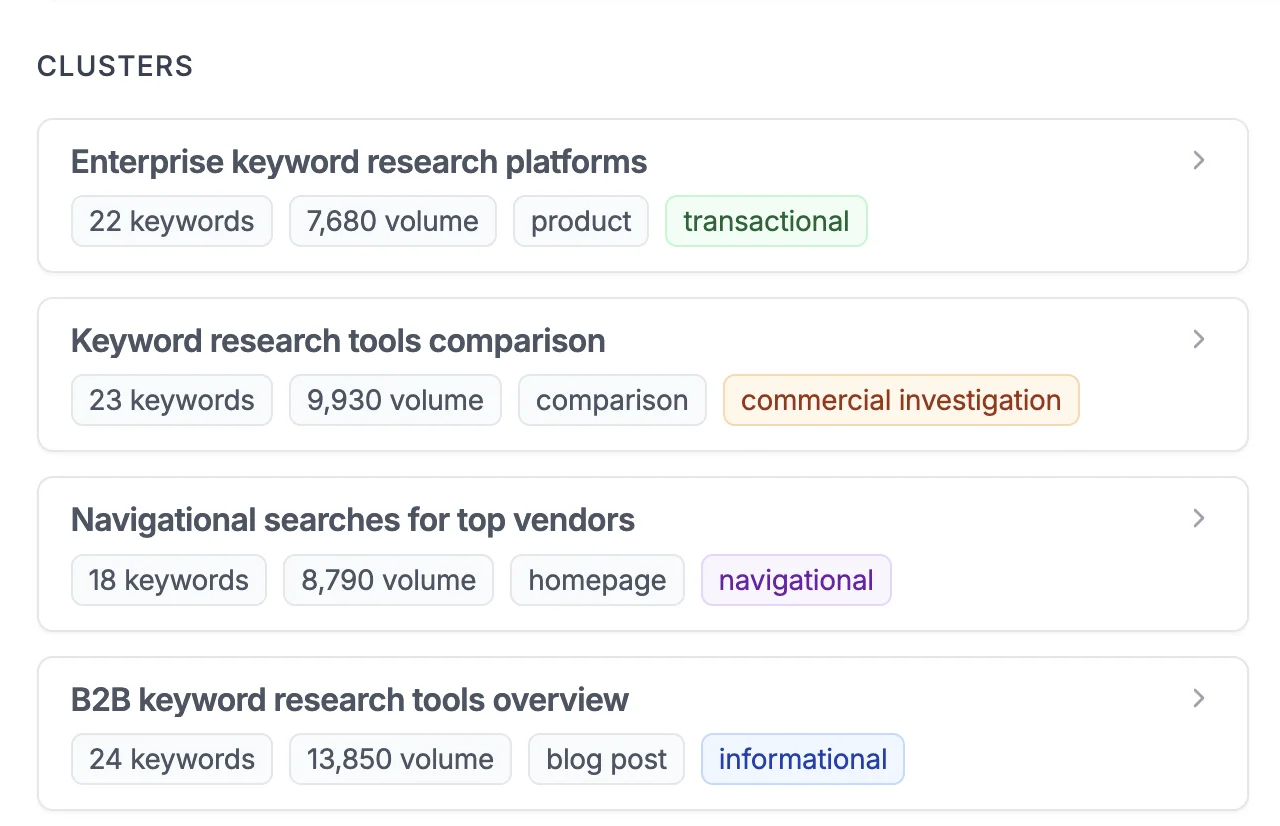
Group Keywords into Content Pieces
One of the biggest mistakes in content planning: creating one page for every keyword. This leads to thin content, cannibalization (multiple pages competing for the same term), and an overwhelming publishing schedule.
The better approach: cluster related keywords and address them in comprehensive content pieces.
Why Keyword Clustering Matters
A single well-written article can rank for dozens or even hundreds of related keywords. Google understands semantic relationships and rewards content that thoroughly covers a topic.
Consider these keywords:
- how to do keyword research
- keyword research for beginners
- keyword research process
- keyword research steps
- how to find keywords for SEO
- keyword research tutorial
Creating six separate articles would be inefficient and confusing to both readers and search engines. Instead, one comprehensive guide titled "How to Do Keyword Research: A Step-by-Step Guide" can target all of them.
How to Cluster Keywords Effectively
Step 1: Identify keyword groups by topic
Look at your keyword list and group terms that share the same core topic or answer the same fundamental question.
Step 2: Check if keywords can share a page
For each group, ask: "Would a single piece of content satisfy users searching for all of these terms?"
If yes, they belong in one content piece. If the intents differ significantly, they need separate pages.
Step 3: Designate primary and secondary keywords
For each cluster:
- Primary keyword: The main term you'll optimize the page for (usually highest volume or most directly relevant)
- Secondary keywords: Related terms you'll incorporate naturally throughout the content
Using Tools to Speed Up Clustering
Manual clustering works for small keyword lists, but becomes tedious with hundreds of terms. AI-powered tools can help. See our guide on using ChatGPT for keyword clustering for detailed prompt templates, or try our free Keyword Clustering tool to group keywords by semantic similarity instantly.
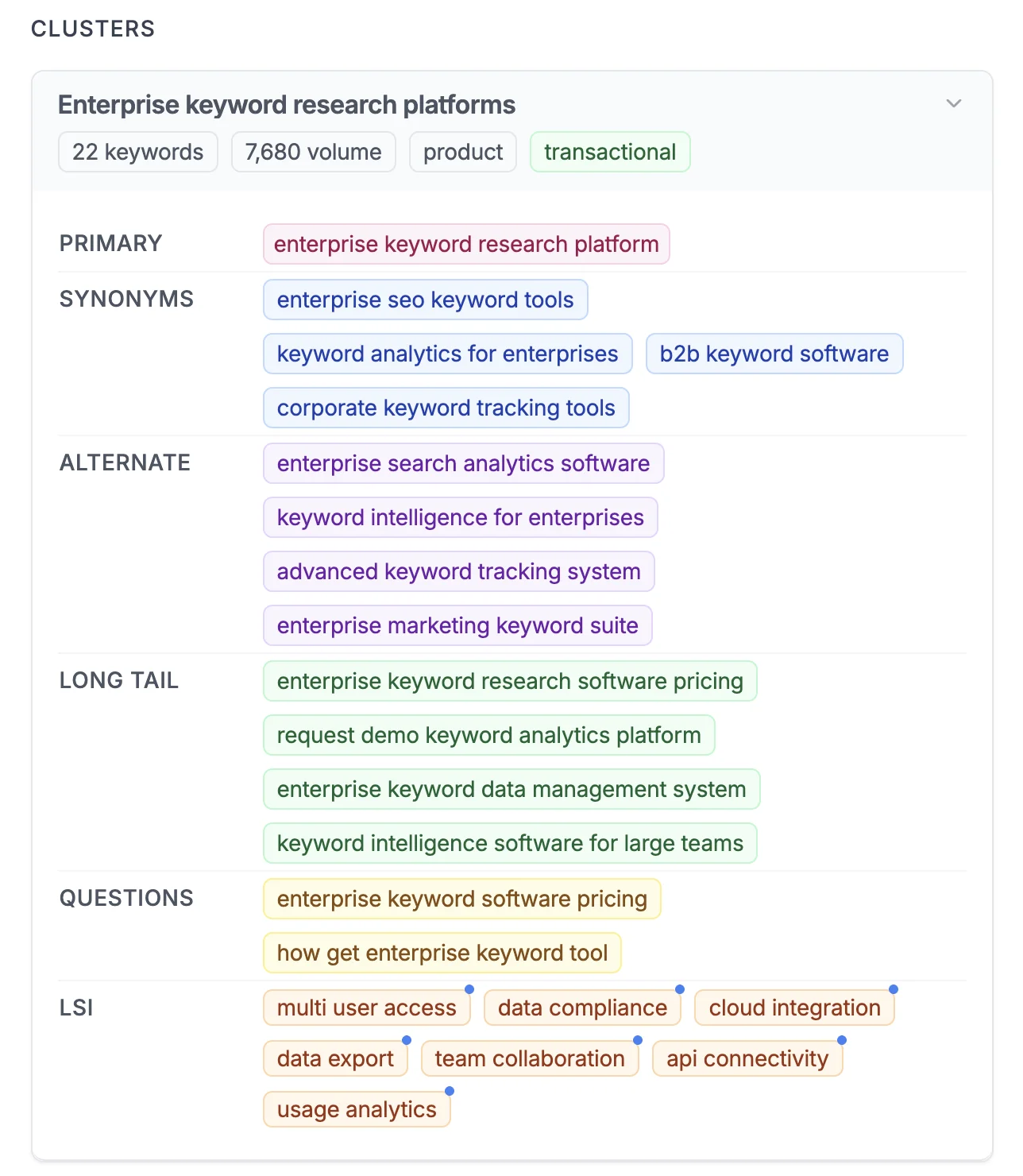
BrightKeyword automatically organizes keywords into intent-based clusters when you research a topic. Each cluster includes:
- A primary keyword
- Related synonyms and variations
- Long-tail alternatives
- Question keywords
- Recommended page type (blog post, comparison page, landing page)
This automated clustering saves hours of manual sorting and ensures you don't miss important keyword relationships.
Deciding on Content Format
Each keyword cluster maps to a content type. Match the format to the search intent:
| Cluster Intent | Recommended Format | Example |
|---|---|---|
| How-to/Process | Step-by-step tutorial | "How to Do Keyword Research" |
| What is/Definition | Explainer article | "What is Search Intent?" |
| Best/Top | Listicle or roundup | "10 Best Keyword Research Tools" |
| Comparison | Versus article | "Ahrefs vs SEMrush" |
| Problem/Solution | Problem-focused guide | "Why Your Keywords Aren't Ranking" |
| Feature/Tool | Product page or demo | "Keyword Clustering Tool" |
When your clusters have clear format assignments, content creation becomes much more straightforward.
Prioritize Which Keywords to Target First
You can't publish everything at once. A content calendar requires prioritization, and the right priority order can dramatically accelerate your results.
The Quick Wins vs. Long-Term Plays Framework
Divide your keyword clusters into two categories:
Quick wins: Keywords where you can realistically rank within 1-3 months
- Lower competition (check difficulty scores)
- Long-tail or niche terms
- Topics where you have existing authority
- Keywords where you already have some rankings
If you're starting from scratch, see our guide on keyword research for new websites for strategies specific to new sites without established authority. Also avoid the common keyword research mistakes that derail many content strategies.
Long-term plays: Keywords that will take 6+ months of consistent effort
- Higher competition, higher volume
- Broad, competitive head terms
- Topics requiring more authority building
- Keywords dominated by major brands
Start with quick wins to build momentum and traffic while investing in long-term plays for sustainable growth.
A Scoring System for Prioritization
Create a simple scoring system to rank your keyword clusters:
| Factor | Weight | How to Score |
|---|---|---|
| Search Volume | 25% | Higher volume = higher score |
| Competition | 25% | Lower competition = higher score |
| Business Relevance | 30% | More aligned with products/services = higher score |
| Content Effort | 20% | Easier to create = higher score |
Score each cluster on a 1-5 scale for each factor, multiply by the weight, and sum for a total priority score.
Example:
| Cluster | Volume (25%) | Competition (25%) | Relevance (30%) | Effort (20%) | Total |
|---|---|---|---|---|---|
| keyword research tips | 4 (1.0) | 3 (0.75) | 5 (1.5) | 4 (0.8) | 4.05 |
| SEO tools comparison | 5 (1.25) | 2 (0.5) | 4 (1.2) | 2 (0.4) | 3.35 |
| local seo guide | 3 (0.75) | 4 (1.0) | 3 (0.9) | 3 (0.6) | 3.25 |
In this example, "keyword research tips" would be the highest priority despite not having the highest search volume, because it combines good volume with manageable competition, high relevance, and reasonable effort. If you also run paid search campaigns, PPC conversion data can further refine these priorities. Learn how to integrate SEO and PPC keyword research for smarter content decisions.
Consider Seasonality and Timing
Some keywords have predictable traffic patterns:
- "Tax software" peaks in Q1
- "Holiday gift ideas" peaks in Q4
- "Summer vacation planning" peaks in spring
For seasonal keywords, work backwards from the peak:
- Identify when search volume spikes
- Subtract 2-3 months for content to gain rankings
- Schedule publication accordingly
If "holiday gift ideas" peaks in November, your content should be live by September to have time to rank.
Account for Content Dependencies
Some content pieces naturally build on others:
- A pillar page on "SEO Basics" should exist before detailed guides on specific tactics
- A "What is X" explainer might be needed before "How to do X" tutorials
- Comparison pages work better when you have foundational content to link from
Map these dependencies and schedule foundational content first.
Assign Topics to Your Editorial Calendar
Now that you have prioritized clusters with assigned formats, it's time to build the actual calendar.
Choosing Your Calendar Format
Pick a format that works for your team. The best content calendar software depends on your team size and workflow complexity:
Simple spreadsheet (Google Sheets, Excel):
- Best for: Solo creators, small teams
- Columns: Publish date, title, primary keyword, secondary keywords, status, author, notes
- Pros: Free, flexible, easy project tracking
- Works perfectly with data from free keyword research tools
Project management tool (Asana, Trello, Monday, Notion):
- Best for: Larger teams with multiple contributors
- Features: Assignment, due dates, status tracking, comments, attachments
- Pros: Built-in team collaboration and kanban view options
Dedicated editorial calendar (CoSchedule, Airtable):
- Best for: Content-focused teams with complex workflows
- Features: Drag-and-drop scheduling, social integration, analytics
- Pros: Workflow automation and marketing reporting built in
The tool matters less than consistency. Pick something your team will actually use.
Setting a Sustainable Publishing Cadence
Be realistic about your capacity:
- Solo creator: 1-2 quality posts per week maximum
- Small team (1-2 writers): 2-4 posts per week
- Content team (3+ writers): 5+ posts per week possible
Quality matters more than quantity. One comprehensive, well-researched article will outperform three thin, rushed pieces.
Consider also:
- Review and editing time: Add 2-3 days between writing and publishing
- Image and asset creation: Graphics, screenshots, and custom images take time
- Promotion tasks: Each published piece needs distribution effort
A sustainable cadence prevents burnout and maintains content quality.
| Date | Title | Primary Keyword | Volume | Status | Author |
|---|---|---|---|---|---|
| Jan 8 | How to Do SEO Keyword Research | seo keyword research | 27,100 | ✅ Published | Sarah |
| Jan 15 | Content Calendar Guide for Marketers | content calendar | 5,400 | ✅ Published | Mike |
| Jan 22 | Editorial Calendar Templates | editorial calendar template | 4,400 | 📝 In Review | Sarah |
| Jan 29 | Keyword Clustering Best Practices | keyword clustering | 1,000 | ✏️ In Progress | Alex |
| Feb 5 | Search Intent Guide | search intent | 1,000 | 📋 Brief Created | Mike |
| Feb 12 | Marketing Calendar for B2B Teams | marketing calendar | 1,900 | 🗓️ Planned | Sarah |
| Feb 19 | Content Strategy for SaaS | seo content strategy | 2,400 | 🗓️ Planned | Alex |
Balancing Content Types
A healthy content calendar includes variety:
- Pillar content (20-30%): Comprehensive guides that anchor topic clusters
- Supporting content (50-60%): Blog posts that target specific questions or subtopics
- Timely content (10-20%): News, trends, or seasonal pieces
- Update/refresh content (10-20%): Improving existing high-potential pages
This mix builds authority (pillars), captures long-tail traffic (supporting), stays relevant (timely), and maximizes existing assets (refreshes).
Sample 3-Month Content Calendar Structure
Here's how a keyword-driven calendar might look for a B2B SaaS blog:
Month 1: Foundation
- Week 1: Pillar post for Cluster A (highest priority)
- Week 2: Supporting post for Cluster A
- Week 3: Supporting post for Cluster A
- Week 4: Pillar post for Cluster B
Month 2: Expansion
- Week 1: Supporting post for Cluster B
- Week 2: Supporting post for Cluster B
- Week 3: Timely/trend piece
- Week 4: Pillar post for Cluster C
Month 3: Depth + Optimization
- Week 1: Supporting post for Cluster C
- Week 2: Content refresh (update Month 1 pillar with new data)
- Week 3: Supporting post for Cluster C
- Week 4: Comparison/commercial intent piece
This structure builds topic clusters systematically while leaving room for timely content and optimization.
Write Content Briefs Using Keyword Insights
A content calendar tells you what to publish and when. Content briefs tell writers exactly what to create. Good briefs translate keyword research into actionable writing guidance.
What to Include in Every Content Brief
1. Target keyword information
- Primary keyword
- Secondary keywords (3-5)
- Search volume and competition data
- Search intent classification
2. Content requirements
- Suggested title (with primary keyword)
- Recommended word count (based on competing content)
- Target audience description
- Key questions to answer
3. Structural guidance
- Suggested H2 and H3 headings
- Topics/subtopics to cover
- FAQ questions to include
4. SEO specifications
- Internal links to include (with anchor text suggestions)
- External sources to reference
- Meta description guidance
5. Competitive context
- Top 3 ranking URLs for the primary keyword
- What competitors cover that you should match
- Gaps or angles competitors miss
Content Brief Template
Here's a template you can adapt:
CONTENT BRIEF

Title: [Suggested title with primary keyword]
Primary Keyword: [keyword] | Volume: [X] | Competition: [low/medium/high]
Secondary Keywords: [list 3-5 with volumes]
Target Word Count: [X-X words]
Search Intent: [informational/commercial/transactional]

TARGET AUDIENCE
[Describe who this content is for and what problem they're trying to solve]

KEY QUESTIONS TO ANSWER
1. [Question based on search intent]
2. [Question from "People Also Ask"]
3. [Question from keyword research]

SUGGESTED STRUCTURE
H1: [Title]
H2: [Section 1 topic]
  - H3: [Subsection if needed]
H2: [Section 2 topic]
H2: [Section 3 topic]
H2: FAQ
H2: Conclusion

INTERNAL LINKS
- Link to [page X] with anchor text "[keyword phrase]"
- Link to [page Y] with anchor text "[keyword phrase]"

COMPETITOR ANALYSIS
Top ranking content:
1. [URL 1] - [What they do well / what they miss]
2. [URL 2] - [What they do well / what they miss]

DIFFERENTIATION ANGLE
[What unique perspective, data, or value can this content provide?]

META DESCRIPTION GUIDANCE
[Include primary keyword, mention the main benefit, stay under 160 characters]
How BrightKeyword Helps with Brief Creation
When you research a topic with BrightKeyword, the output naturally feeds into content briefs:
- Primary keyword: From the cluster's designated primary term
- Secondary keywords: Synonyms, long-tail variants, and LSI terms
- Questions to answer: From the question keywords in each cluster
- Search intent: Each cluster includes intent classification
- Page type recommendation: Guides your format decision
Instead of manually combing through keyword data, you can export clusters directly and use them as the foundation for your briefs.
Assigning Briefs to Writers
When handing off briefs:
- Provide context: Explain why this topic matters and how it fits the broader strategy
- Set clear expectations: Specify deadline, word count, and quality standards
- Share examples: Link to similar content (yours or competitors') that demonstrates the desired quality
- Be available for questions: Writers produce better content when they can clarify ambiguities
Good briefs reduce revision cycles and ensure the final content matches your keyword strategy.
Workflow Tips for Staying Organized
A content calendar only works if you maintain it. Effective data management and team collaboration systems keep the process running smoothly.
Use Status Labels to Track Progress
Every content piece should have a clear status for project tracking:
- Planned: On the calendar but not started
- Brief Created: Research done, ready for writing
- In Progress: Writer actively working
- In Review: Draft complete, under editorial review
- Ready to Publish: Approved and scheduled
- Published: Live on the site
- Needs Update: Published but flagged for refresh
Visual status tracking (color coding in spreadsheets or kanban view in project tools) makes it easy to see your pipeline at a glance.
Maintain a Backlog of Ideas
Not every keyword cluster will make it onto the immediate calendar. Keep a prioritized backlog of:
- Keyword clusters not yet scheduled
- Content ideas from team brainstorms
- Topics requested by sales or support
- Competitor content gaps you've identified
When a scheduled piece falls through or you have extra capacity, pull from the backlog.
Build Templates for Repeatability
Create templates for:
- Content briefs: Pre-formatted documents with all required sections
- Blog post structure: Standard formatting for headings, images, CTAs
- Editorial checklist: Pre-publish quality checks
Templates reduce decision fatigue and ensure consistency across all content.
Schedule Regular Planning Sessions
Block time for content planning:
- Weekly (30 min): Review upcoming deadlines, address blockers, adjust priorities
- Monthly (1-2 hours): Review performance, plan next month's content, refresh keyword research
- Quarterly (half day): Strategic review, goal setting, major calendar updates
Regular planning prevents the calendar from becoming stale or disconnected from current priorities.
Monitor and Iterate on Your Plan
A content calendar isn't "set it and forget it." The best content teams continuously learn from performance data and adjust their approach.
Track Performance by Keyword Cluster
For each piece of published content, monitor these performance metrics:
- Rankings: Are you ranking for the target keywords? Track position changes over time.
- Organic traffic: How many visits is the content generating?
- Engagement: Time on page, bounce rate, scroll depth
- Conversions: Signups, downloads, or other goal completions
Set up KPI tracking through a dashboard or spreadsheet linking content pieces to their target clusters. Monitor search trends to spot rising opportunities and update your marketing reporting monthly.
What the Data Tells You
Use performance data to inform future planning:
If rankings are good but traffic is low:
- The keyword might have less volume than tools estimated
- Featured snippets or ads might be stealing clicks (see our guide on keyword research for AI search and zero-click results)
- Consider expanding the content to capture more related terms
If traffic is good but conversions are low:
- The keyword might attract the wrong audience
- Your CTA might need improvement
- Consider adding more commercial intent content to capture intent
If you're not ranking at all:
- The content might need more depth or quality
- You might need more backlinks or internal links
- The keyword might be too competitive right now
Hold Monthly Content Reviews
Set a monthly meeting to review:
- What was published last month: Quick overview of new content
- Early performance signals: Rankings, traffic, engagement for recent posts
- Mature content performance: How are pieces from 3-6 months ago doing?
- Next month preview: What's coming up on the calendar
- Adjustments needed: Should anything be reprioritized?
These reviews keep the team aligned and responsive to what the data shows.
Update Keyword Research Quarterly
Search behavior changes. New keywords emerge. Competition shifts. Refresh your SEO keyword research every quarter:
- Research new keywords for existing topic areas
- Identify trending or emerging topics by monitoring search trends
- Re-evaluate keyword difficulty (some may have become easier or harder)
- Look for new content gaps based on competitor monitoring and analysis
- Consider expanding to international markets if your business serves global audiences
Feed these insights back into your marketing calendar as updated priorities or new additions to the backlog. This continuous keyword optimization keeps your content strategy aligned with what your audience actually searches for.
Example: From Keyword Cluster to Scheduled Content
Let's walk through a complete example of turning keyword research into a calendar entry.
The Keyword Research
Using BrightKeyword, you research "email marketing automation" and get this cluster:
| Keyword | Type | Volume | Competition |
|---|---|---|---|
| email marketing automation | Primary | 8,100 | High |
| marketing automation email | Synonym | 1,300 | Medium |
| automated email marketing | Long-tail | 720 | Medium |
| email automation workflow | Long-tail | 480 | Low |
| how to automate email marketing | Question | 390 | Low |
| best email automation tools | Commercial | 1,600 | High |
| email marketing automation examples | Long-tail | 320 | Low |
The Analysis
- Primary keyword has high volume but high competition
- Several long-tail variants have lower competition
- A question keyword suggests informational intent
- A commercial keyword suggests buyers are also searching this topic
The Content Plan
Based on this cluster, you plan two pieces of content:
Piece 1: Pillar Content (Informational)
- Title: "Email Marketing Automation: The Complete Guide for 2026"
- Primary keyword: email marketing automation
- Secondary: automated email marketing, email automation workflow
- Format: Comprehensive guide (3,000+ words)
- Priority: High (builds foundational authority)
- Publish: Month 1, Week 2
Piece 2: Supporting Content (Commercial)
- Title: "7 Best Email Automation Tools Compared"
- Primary keyword: best email automation tools
- Secondary: email marketing automation examples
- Format: Comparison listicle (2,000 words)
- Priority: Medium (publish after pillar to link from)
- Publish: Month 2, Week 1
The Calendar Entry
| Date | Title | Primary KW | Volume | Type | Status |
|---|---|---|---|---|---|
| Jan 15 | Email Marketing Automation: Complete Guide | email marketing automation | 8,100 | Pillar | Planned |
| Feb 5 | 7 Best Email Automation Tools Compared | best email automation tools | 1,600 | Comparison | Planned |
The Content Brief (Pillar)
Title: Email Marketing Automation: The Complete Guide for 2026
Primary KW: email marketing automation (8,100/mo, high competition)
Secondary: automated email marketing, email automation workflow,
          how to automate email marketing
Word Count: 3,000-3,500

STRUCTURE:
H2: What is Email Marketing Automation?
H2: Benefits of Automating Your Email Marketing
H2: How Email Marketing Automation Works
H2: Essential Email Automation Workflows
  H3: Welcome Series
  H3: Abandoned Cart
  H3: Re-engagement Campaigns
H2: How to Get Started with Email Automation
H2: Email Marketing Automation Best Practices
H2: FAQ
H2: Conclusion

INTERNAL LINKS:
- Link to [email marketing basics guide]
- Link to [BrightKeyword for keyword research]

DIFFERENTIATION:
Include real workflow examples with screenshots.
Add a section on measuring automation ROI.
This systematic approach ensures every piece of content has clear keyword targeting, fits into the broader calendar, and gives writers everything they need to execute.
Frequently Asked Questions
What is a content calendar?
A content calendar (also called an editorial calendar or marketing calendar) is a planning document that schedules what content you'll publish and when. It transforms your SEO keyword research into an actionable publishing roadmap, ensuring consistent content production aligned with your keyword strategy.
What is keyword mapping?
Keyword mapping is the process of assigning specific keywords to specific pages or planned content pieces. Each URL targets a primary keyword plus related secondary terms. This prevents keyword cannibalization (multiple pages competing for the same term) and ensures comprehensive topic coverage.
How do SEO topic clusters work?
SEO topic clusters organize content around a central pillar page and multiple supporting articles. The pillar covers a broad topic comprehensively, while cluster content targets specific long-tail keywords. Internal links connect them, signaling to search engines that you're an authority on the subject.
How many keywords should one piece of content target?
One primary keyword and 3-10 secondary keywords is typical. A comprehensive guide might naturally rank for 50+ related terms, but you're actively targeting a focused cluster. Don't try to stuff unrelated keywords into a single piece.
How far in advance should I plan my editorial calendar?
Plan at least 1 month ahead in detail, with a rough outline for 3 months. Beyond 3 months, priorities change too much for detailed planning. Keep a backlog for longer-term ideas.
What if a keyword doesn't have search volume data?
Some long-tail or emerging keywords won't show volume in tools. If the keyword is relevant to your audience and comes from reliable sources (customer questions, forum discussions, GSC data), it may still be worth targeting. Trust qualitative signals alongside quantitative data. Learn how to mine Google Search Console for hidden keyword opportunities that tools miss.
What's the best content calendar software for marketing teams?
It depends on your team size and needs. Small teams often succeed with Google Sheets or Notion. Larger teams benefit from dedicated tools like CoSchedule, Airtable, or Monday.com that offer workflow automation and team collaboration features. The best tool is one your team will actually use consistently.
How do I align content with SEO goals?
Start with keyword research to identify what your audience searches for. Group keywords by search intent, then create content that matches each intent type. Track performance metrics (rankings, traffic, conversions) to measure alignment between your content marketing plan and SEO objectives.
What's more important: search volume or keyword difficulty?
Neither alone. The best targets balance both with business relevance. A low-difficulty keyword with 100 searches that converts is better than a high-volume keyword you'll never rank for. Use a scoring system that weighs multiple factors for keyword optimization.
How do I know if my content calendar is working?
Track organic traffic growth month over month. Are the keywords you're targeting improving in rankings? Is organic traffic contributing to business goals (leads, signups, sales)? If you're publishing consistently and not seeing progress after 3-6 months, revisit your keyword selection or content quality.
Can I automate parts of this process?
Yes. Tools like BrightKeyword automate keyword clustering and intent classification. Project management tools can automate status updates and reminders. But the strategic decisions, prioritization, and quality control still require human judgment.
Turn Your Keywords into Published Content
SEO keyword research is only valuable when it leads to action. The strategies in this guide bridge the gap between data and execution, transforming keyword planning into a systematic content marketing plan:
- Group keywords into clusters to create comprehensive content that ranks for multiple terms
- Prioritize by impact using a scoring system that balances volume, competition, and relevance
- Build a realistic editorial calendar with sustainable publishing cadence and content variety
- Create detailed briefs that translate keyword insights into writer-ready instructions
- Monitor performance metrics and iterate based on data to continuously improve your SEO content strategy
Here's your action plan for this week:
- Export your keyword research from BrightKeyword or your preferred tool
- Group keywords into clusters based on shared topics and search intent
- Score and prioritize 5-10 clusters using the framework above
- Add the top 3-4 to your content calendar for the next month
- Create a content brief for the first piece with keyword optimization in mind
The gap between SEO keyword research and organic traffic isn't a mystery. It's a process. And now you have the system to close that gap.
Start building your content calendar today. Your future traffic depends on it.