
60% of Google Searches End Without a Click. Now What?
Google AI Overviews answer questions directly in search results. Featured snippets steal clicks before users reach your site. And studies show over 60% of Google searches end without anyone clicking anything.
Your keyword research playbook from 2020? It's outdated.
The old approach was simple: find keywords with high volume, create content, rank on page one, get traffic. That worked when users had to click to get answers. Now they often don't.
But this isn't the death of SEO. The keywords worth targeting have changed. The content formats that win have shifted. The metrics that matter are different. And the opportunities for those who adapt are real.
In this guide, you'll learn which keywords still drive clicks (and which don't), how to optimize for AI Overviews and featured snippets, and how to measure success when fewer people click through to your site.
SEOs who fight this change lose. SEOs who adapt their keyword strategy win.
What Are Zero-Click Searches and AI Overviews?
Before adjusting your keyword strategy, you need to understand what's actually happening in search results.
What Is Zero-Click Search?
A zero-click search happens when someone gets their answer directly on Google's results page without clicking through to any website. Common examples:
- Knowledge panels: "How old is Tom Hanks?" shows the answer immediately
- Featured snippets: Step-by-step instructions displayed at the top of results
- AI Overviews: AI-generated summaries answering complex questions
- Local packs: Business information with maps, hours, and contact details
- Calculators and converters: Unit conversions, math calculations, currency exchange
Studies consistently show that 60-65% of Google searches now end without a click to any website. For mobile searches, that number is even higher.
What Are Google AI Overviews?
Google AI Overviews (formerly part of the Search Generative Experience) are AI-generated summaries that appear at the top of search results for many queries. They pull information from multiple sources to answer questions directly.
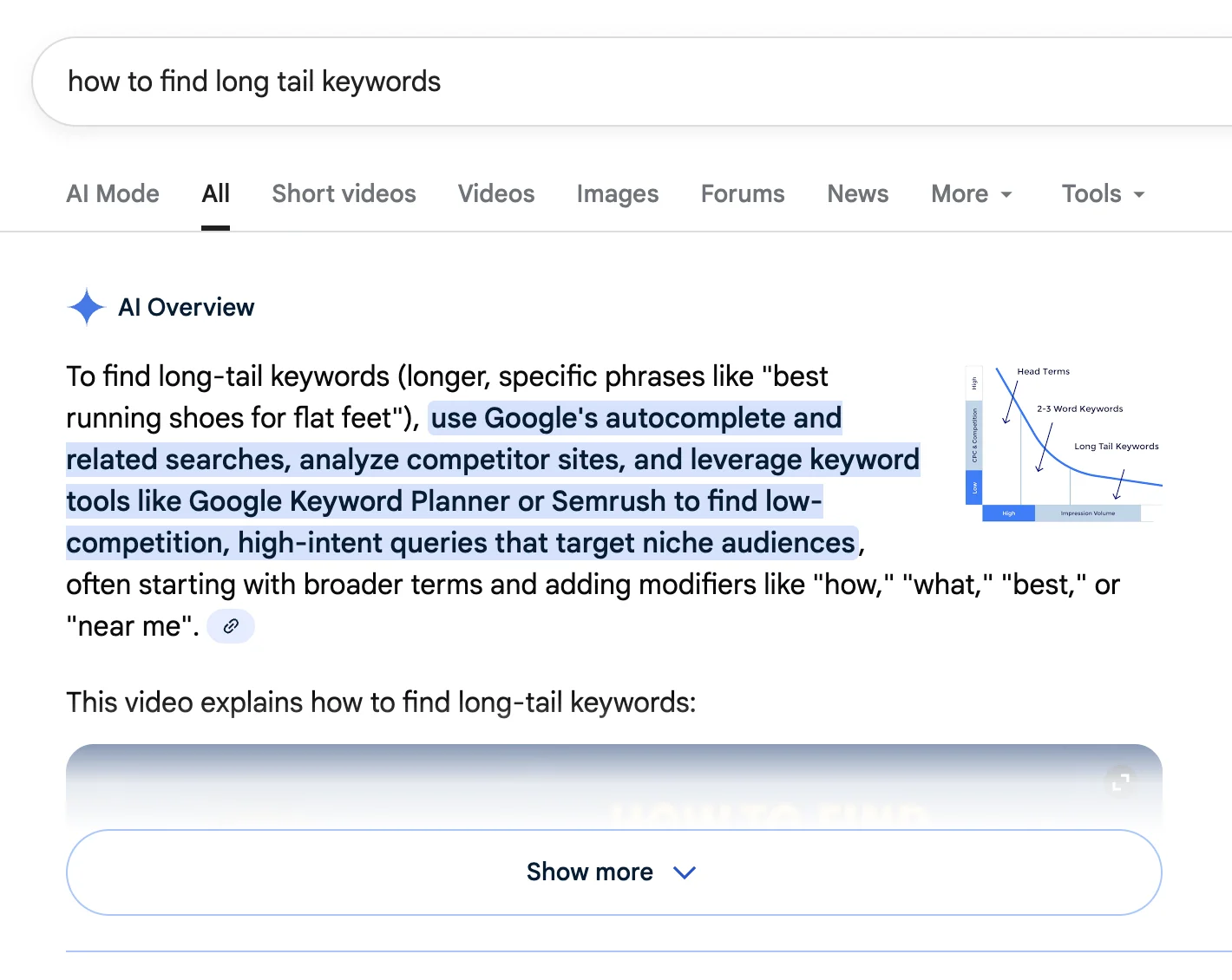
Key characteristics:
| Feature | How It Works |
|---|---|
| Triggered by questions | Complex, multi-part queries often generate AI Overviews |
| Source synthesis | Pulls from multiple websites, citing sources inline |
| Expandable depth | Users can click to see more detail or follow-up questions |
| Dynamic generation | Content is generated per query, not pre-cached |
AI Overviews don't replace all search results. They add to them. But for informational queries, they often give users enough information that clicking feels unnecessary.
Why This Changes Keyword Research
Traditional keyword research focused on volume and ranking position. The assumption: rank #1, capture the majority of clicks.
That assumption breaks down when:
The answer appears above all organic results. Position zero (featured snippets, AI Overviews) captures attention before position one.
Users get answers without clicking. High rankings don't translate to traffic for many query types.
Search intent has more dimensions. Google's AI understands natural language queries differently than keyword-matched results.
Content depth matters more. AI Overviews pull from thorough sources, not just keyword-optimized pages.
Your keyword strategy must account for these realities.
Which Keywords Still Drive Clicks (And Which Don't)
Not all keywords are equally affected by zero-click behavior. Understanding the differences helps you prioritize your efforts.
Keywords That Still Generate Clicks
Commercial and transactional queries:
Users researching purchases still click through to compare options, read reviews, and buy. "Best project management software for agencies" drives clicks because the decision requires evaluation.
Complex topics requiring depth:
AI Overviews provide summaries, but users seeking deep understanding still click through. "How to build a content strategy from scratch" needs more than a snippet can provide.
Comparison and versus queries:
"Notion vs Obsidian" or "React vs Vue for enterprise" require nuanced evaluation that summaries can't fully capture.
Brand and navigational queries:
Users searching for specific brands or products generally intend to visit those sites.
Local with transaction intent:
"Plumber near me reviews" drives clicks because users need to evaluate and contact service providers.
Keywords Losing Click Potential
Simple factual queries:
"Capital of France" or "When did World War 2 end" get answered instantly. These keywords have near-zero click potential now.
Definition queries:
"What is SEO" or "What does CRM stand for" are answered in featured snippets and AI Overviews.
How-to queries with simple answers:
"How to boil an egg" or "How to tie a tie" can be fully answered in a snippet or video preview.
Calculator and conversion queries:
Google's built-in tools handle these without any external click.
Weather, sports scores, stock prices:
Real-time data queries are handled directly in SERPs.
The Gray Zone: Queries Worth Fighting For
Some queries show AI Overviews but still generate meaningful clicks:
- Users wanting more depth than the summary provides
- Users who prefer specific sources they trust
- Users on research journeys who will click multiple results
- Queries where the AI Overview cites your content (driving brand awareness even without clicks)
For these queries, appearing in the AI Overview itself becomes a new form of "ranking."
How to Adapt Your Keyword Research
Here's how to modify your keyword research process for AI search.
Step 1: Analyze SERP Features Before Targeting
Before committing to any keyword, search it and document what appears:
| SERP Feature | Impact on Clicks | Strategy |
|---|---|---|
| AI Overview present | Moderate reduction | Optimize for inclusion in overview |
| Featured snippet present | Significant reduction for simple queries | Target the snippet position |
| Knowledge panel | Severe reduction | Likely skip unless brand-related |
| Video carousel | Depends on query | Consider video content |
| People Also Ask | Opportunity | Target related questions |
| Local pack | Moderate for local | Essential for local businesses |
| No special features | Best click potential | Prioritize these keywords |
For keyword research, use BrightKeyword to discover keyword clusters, then manually verify SERP features for your top candidates.
Step 2: Prioritize Commercial and Comparison Keywords
Shift your keyword mix toward queries with inherent click intent:
Instead of: "What is email marketing"
Target: "Best email marketing software for small business"
Instead of: "How to do keyword research"
Target: "Keyword research tools comparison 2026"
Instead of: "What is a landing page"
Target: "Landing page builders for course creators"
The commercial and comparison angles survive AI Overviews because users need to evaluate options themselves.
Step 3: Target Natural Language Queries
AI search understands conversational queries better than ever. This creates opportunities for content that matches how people actually ask questions.
Traditional keyword: "email marketing tips"
Natural language variant: "how do I improve my email open rates"
Traditional keyword: "SEO tools"
Natural language variant: "what tools do I need to track my search rankings"
These longer, conversational queries often have:
- Lower competition (fewer sites optimize for exact phrases)
- Higher intent (specific questions indicate engaged users)
- Better AI Overview alignment (your content may be sourced)
Use Google's "People Also Ask" boxes to discover natural language queries in your niche.
Step 4: Build Topic Clusters, Not Keyword Lists
AI search rewards topical authority. A single page won't capture complex topics the way a content cluster will.
Cluster approach for "email marketing":
PILLAR: Complete Guide to Email Marketing (thorough, 5,000+ words)

CLUSTER CONTENT:
├── Email Marketing for E-commerce (audience-specific)
├── Email Automation Workflows (tactical depth)
├── Email List Building Strategies (supporting topic)
├── Email Deliverability Guide (technical depth)
├── Email Marketing Metrics That Matter (measurement)
└── Email Marketing Tool Comparisons (commercial intent)

Internal links connect all pieces, building topical authority.
AI Overviews often pull from sites with demonstrated expertise across a topic, not just single optimized pages. Keyword clustering helps you build this authority systematically.
For detailed guidance on clustering keywords effectively, see our guide on avoiding common keyword research mistakes.
How to Optimize for Featured Snippets and Position Zero
If you can't beat zero-click results, join them. Appearing in featured snippets and AI Overviews maintains visibility even when users don't click.
Types of Featured Snippets
| Snippet Type | Trigger | Optimization Strategy |
|---|---|---|
| Paragraph | What/why/how questions | Direct answer in 40-60 words |
| List | Step-by-step or ranked items | Use ordered/unordered lists |
| Table | Comparison data | Format data in HTML tables |
| Video | How-to demonstrations | Create and embed video |
Snippet Optimization Tactics
1. Answer the question directly and early
Structure your content to provide a concise answer within the first paragraph after the question heading:
## What Is Zero-Click Search?

Zero-click search occurs when users find their answer directly
on Google's results page without clicking through to any website.
This includes featured snippets, knowledge panels, AI Overviews,
and other SERP features that display information inline.

[Expanded explanation follows...]
2. Use proper heading structure
Featured snippets often pull content from sections with clear H2/H3 headings that match the query:
- H2 for main questions/topics
- H3 for sub-questions or steps
- Content immediately following the heading should answer it directly
3. Format for snippet types
For list snippets, use actual HTML lists:
- Numbered lists for processes and rankings
- Bullet lists for feature lists and options
For table snippets, use actual HTML tables with clear headers.
4. Target "People Also Ask" questions
PAA boxes reveal questions Google associates with your target keyword. Each PAA question is a potential featured snippet opportunity.
Getting Into AI Overviews
AI Overviews synthesize information differently than featured snippets. Tactics that help:
Thorough coverage: AI Overviews pull from sources that fully cover topics. Thin content rarely appears.
Clear, factual statements: AI prefers content with clear, quotable facts and explanations.
Structured data (schema markup): Helps Google understand your content's meaning and structure.
Authority signals: Sites with demonstrated expertise (backlinks, topical coverage, E-E-A-T signals) appear more frequently in AI Overviews.
For a deeper dive into finding keywords where AI systems are likely to cite your content as a source, see our guide on keyword research for LLM visibility.
Using Schema Markup for AI Search Visibility
Schema markup helps search engines understand your content's structure and meaning. With AI search, this understanding matters even more.
Essential Schema Types for SEO
| Schema Type | Use Case | Benefit |
|---|---|---|
| Article | Blog posts, news | Identifies content type and metadata |
| HowTo | Step-by-step guides | Can trigger rich results and AI parsing |
| FAQ | Question-answer content | FAQ rich results, PAA inclusion |
| Product | E-commerce pages | Rich product information in results |
| Review | Review content | Star ratings in search results |
| Organization | About/company pages | Knowledge panel information |
Implementing Schema for AI Readability
Beyond triggering rich results, schema markup helps AI systems understand:
- What questions your content answers
- The structure and hierarchy of information
- Key facts and data points
- Relationships between concepts
Example: HowTo schema signals to AI systems that your content provides step-by-step instructions, making it more likely to be sourced for procedural queries.
Schema Markup Best Practices
- Use JSON-LD format (Google's preferred method)
- Mark up your most important content types (don't over-mark)
- Test with Google's Rich Results Test before deploying
- Keep schema accurate (misrepresentation can hurt rankings)
Measuring Success When Clicks Decline
Traditional SEO metrics (rankings, traffic, clicks) don't capture the full picture with zero-click search. You need additional metrics.
Beyond Click Metrics
Impressions matter more:
In Google Search Console, track impressions alongside clicks. High impressions with low CTR on informational queries isn't necessarily failure. It may mean your content appears in AI Overviews or featured snippets, providing value without clicks.
Brand search volume:
Users who see your brand in AI Overviews may search for you directly later. Track branded search volume over time as a proxy for visibility impact.
Share of voice:
How often does your content appear for important queries in your niche? This matters even without direct clicks.
Search Console Analysis for AI Search
Use Google Search Console to understand zero-click impact:
High impressions, low clicks:
- Check if the query triggers AI Overviews or featured snippets
- Your content may be sourced without generating direct clicks
- This can still drive brand awareness and authority
Declining CTR over time:
- May indicate increased SERP feature competition
- Compare against industry benchmarks (CTR varies by query type)
Query analysis:
- Which queries still drive clicks vs. which have become zero-click?
- Adjust content strategy accordingly
For advanced Search Console analysis techniques, see our guide on mining GSC for keyword opportunities.
New Metrics to Track
| Metric | What It Measures | How to Track |
|---|---|---|
| Featured snippet ownership | Position zero visibility | Manual SERP tracking or rank tools |
| AI Overview appearances | Content sourced by AI | Manual monitoring (no automated tool yet) |
| Brand search trend | Indirect visibility impact | GSC branded queries over time |
| Impression growth | Overall search visibility | GSC performance report |
| Content engagement | Value for users who do click | Time on page, pages per session |
What This Means for Your Keyword Strategy
AI search will keep changing. Here's how to build a keyword strategy that holds up.
Focus on What Actually Works
1. Prioritize expertise and depth
AI systems increasingly evaluate content quality. Surface-level, keyword-stuffed content won't compete. Deep, genuinely useful content will.
2. Build topical authority systematically
Full coverage of your niche signals expertise to both users and AI. Use keyword clusters to build authority across related topics.
3. Focus on user problems, not just keywords
Keywords are proxies for user needs. Understand the problems your audience faces, then create content that solves them. This content naturally targets valuable keywords.
4. Maintain technical SEO fundamentals
Schema markup, site speed, mobile optimization, and crawlability remain essential. AI search layers on top of traditional SEO. It doesn't replace it.
5. Diversify traffic sources
Don't rely solely on organic search. Email lists, social presence, and direct traffic provide stability as search changes.
Keywords to Research Now
As AI search matures, explore:
- Longer, more specific queries
- Question-based variations
- Comparison and evaluation frameworks
- Topics where human judgment and experience matter
Voice search and AI assistants will drive more natural language queries. Users are learning they can ask detailed questions. Your keyword research should reflect this.
Frequently Asked Questions
Is SEO dead because of AI search?
No. SEO is changing, not dying. Organic search still drives significant traffic for commercial queries, complex topics, and navigational searches. The keywords worth targeting and the optimization tactics have changed, but the fundamental value of search visibility remains.
Should I stop targeting informational keywords?
Not entirely. Informational content builds topical authority that helps your commercial pages rank. It also appears in AI Overviews, building brand awareness. But balance informational content with commercial keywords that still drive clicks.
How do I know if my content appears in AI Overviews?
Currently, there's no automated tool that reliably tracks AI Overview appearances. Manual monitoring (searching your target queries and checking results) remains the most reliable method. Google Search Console doesn't yet report on AI Overview sourcing.
Do featured snippets still matter with AI Overviews?
Yes. Featured snippets appear for many queries where AI Overviews don't trigger. They're also often sourced by AI Overviews when they do appear. Optimizing for featured snippets serves double duty.
How do I optimize for voice search?
Voice search queries tend to be longer and more conversational. Target natural language variations of your keywords. Structure content to directly answer questions. Use FAQ schema to signal question-answer content.
What's more important: search volume or click potential?
Click potential, especially for informational queries. A keyword with 10,000 searches but zero-click results provides less value than a keyword with 1,000 searches and strong click-through. Evaluate SERP features before prioritizing keywords.
Should I use AI to create content for AI search?
AI-assisted content creation can work, but quality matters more than production method. AI-generated content that lacks depth, accuracy, or originality won't compete. Use AI as a tool to enhance human expertise, not replace it.
The Clicks Are Still There. You Just Have to Find Them.
Zero-click search and AI Overviews aren't going away. Your keyword research strategy needs to account for this reality.
Here's what to do:
Evaluate SERP features before committing to keywords. High volume means nothing if zero-click results capture all the value.
Prioritize commercial and comparison keywords where users still click through to evaluate options.
Target natural language queries that match how users actually ask questions.
Build topic clusters to establish the authority AI systems recognize.
Optimize for featured snippets and AI Overviews to maintain visibility in zero-click results.
Measure success beyond clicks using impressions, brand search, and share of voice.
The SEOs who struggle are those using keyword strategies designed for 2015. The SEOs who win are adapting to how search actually works today.
Your content can still drive significant traffic from organic search. You just need to target the right keywords, create the right content formats, and measure success with the right metrics.
The opportunity hasn't disappeared. It's shifted. Go find it.