
Your Content Ranks #1. ChatGPT Doesn't Mention It. Now What?
You did everything right. Your page ranks on the first page of Google. Your traffic is solid. Then someone asks ChatGPT the same question your content answers, and your brand doesn't appear anywhere in the response.
This is the new reality of search. Ranking on Google is no longer enough. If AI systems like ChatGPT, Perplexity, and Google's AI Overviews don't cite your content as a source, you're invisible to a growing segment of searchers.
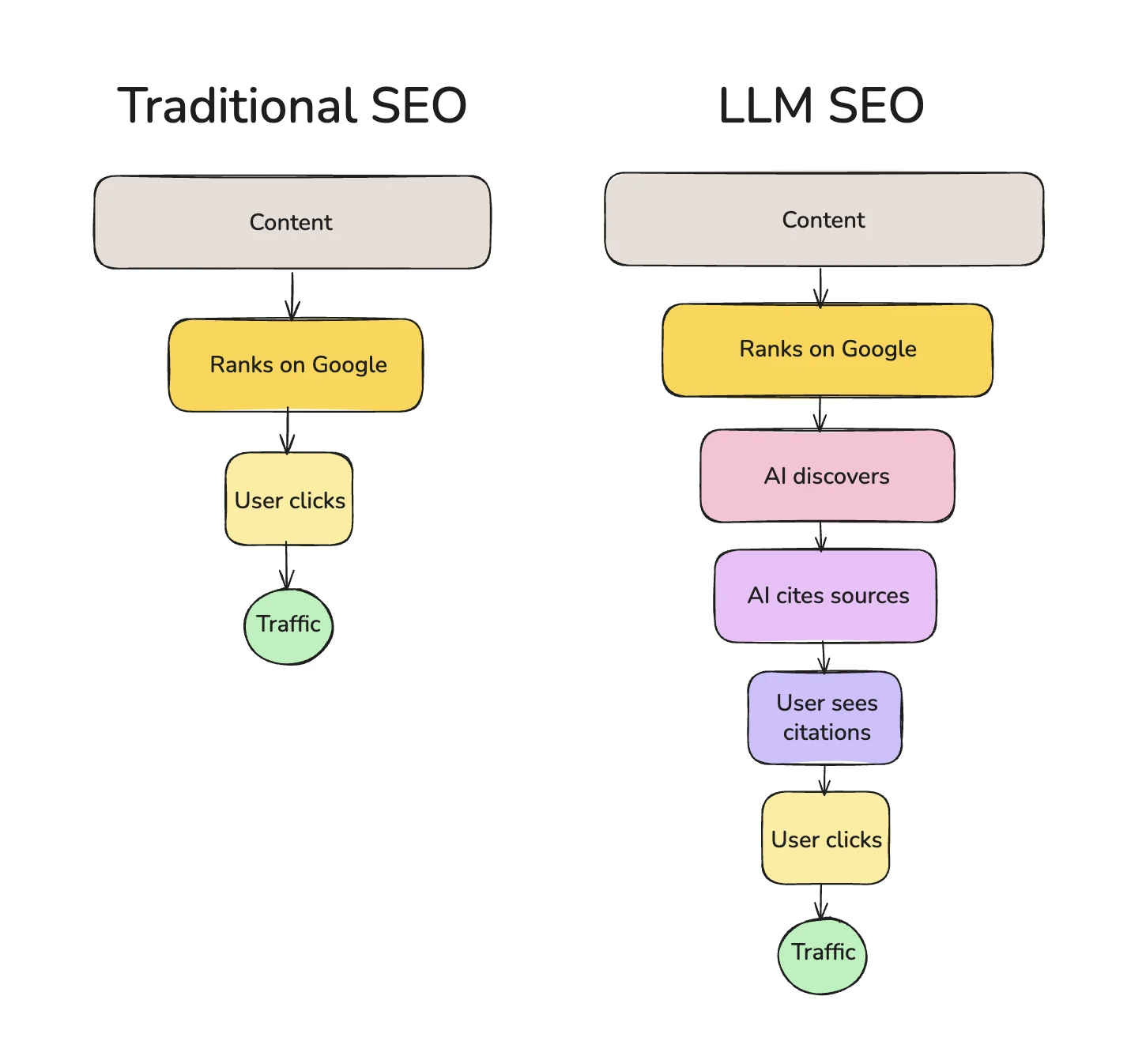
Traditional keyword research focused on one goal: rank higher. But LLM SEO, the practice of optimizing for Large Language Model visibility, requires a different approach. You need to find keywords where your content can become a cited source, not just a ranked page.
In this guide, you'll learn how to identify keywords where AI systems are likely to cite sources, how to structure your keyword research for entity-based discovery, and how to evaluate whether a keyword will still deliver value as AI search grows.
The game has changed. Your keyword research needs to change with it.
What Is LLM SEO (And Why Keyword Research Matters)
LLM SEO refers to optimizing your content to be cited, referenced, or surfaced by Large Language Models like ChatGPT, Claude, Perplexity, and Google's AI Overviews.
Unlike traditional SEO where you compete for ranking positions, LLM SEO is about becoming a trusted source that AI systems pull information from when generating answers.
How AI Systems Choose What to Cite
When an AI generates a response to a query, it doesn't just regurgitate training data. Modern AI search systems like Perplexity and Google's AI Overviews actively:
- Search the web for current, relevant content
- Evaluate source authority based on content structure and credibility signals
- Extract specific information from pages with clear, structured data
- Cite sources that provide definitive, quotable answers
This means your content needs to be findable, structured, and quotable for AI systems to cite it.
Why Keyword Research Changes
Traditional keyword research asks: "What terms have high volume and achievable competition?"
LLM-focused keyword research asks additional questions:
| Traditional Approach | LLM-Focused Approach |
|---|---|
| What's the search volume? | Will AI answer this without citing sources? |
| Can I rank for this? | Can I become THE source AI cites? |
| What's the keyword difficulty? | Does this topic require original data or proof? |
| What's the search intent? | Will users still click after seeing an AI answer? |
The keywords worth targeting have fundamentally shifted. Let's look at how to find them.
Which Keywords Get Your Content Cited by AI
Not all keywords are equal in the AI search era. Some queries get answered completely by AI with no sources cited. Others almost always include citations because the AI needs external verification.
Understanding this distinction is the foundation of LLM keyword research.
Keywords AI Answers Without Citations (Avoid These)
AI systems confidently answer these queries from training data alone:
- Simple definitions: "What is SEO?"
- Basic factual lookups: "When was Google founded?"
- Common how-to queries: "How to write a meta description"
- General explanations: "Why is keyword research important?"
For these queries, AI provides complete answers without needing to cite sources. Even if you rank #1 on Google, the AI response doesn't mention you.
These keywords have low LLM visibility potential. Unless you have a unique angle, deprioritize them.
Keywords AI Almost Always Cites Sources For (Target These)
AI systems cite external sources when they need:
1. Current data and statistics
- "SEO statistics 2025"
- "Average conversion rate by industry"
- "How much does SEO cost"
AI can't fabricate current numbers. It must cite sources. If you have original data, you become citable.
2. Comparisons requiring research
- "Ahrefs vs Semrush for keyword research"
- "Best keyword research tools for agencies"
- "WordPress vs Webflow for SEO"
AI can't make up feature comparisons. It pulls from sources that have done the comparison work.
3. Specific how-to processes with steps
- "How to do keyword research for a new website step by step"
- "How to set up Google Search Console"
- "How to audit technical SEO"
When queries ask for specific, detailed processes, AI cites sources with complete step-by-step guides.
4. Industry-specific or niche topics
- "Keyword research for B2B SaaS"
- "Local SEO for dentists"
- "Enterprise SEO strategy"
AI has less training data on niche topics. It relies more heavily on external sources.
5. Topics requiring first-hand experience
- "Common keyword research mistakes"
- "What I learned from 100 SEO audits"
- "How we increased organic traffic 300%"
AI can't manufacture first-hand experience. Content with real case studies and examples gets cited.
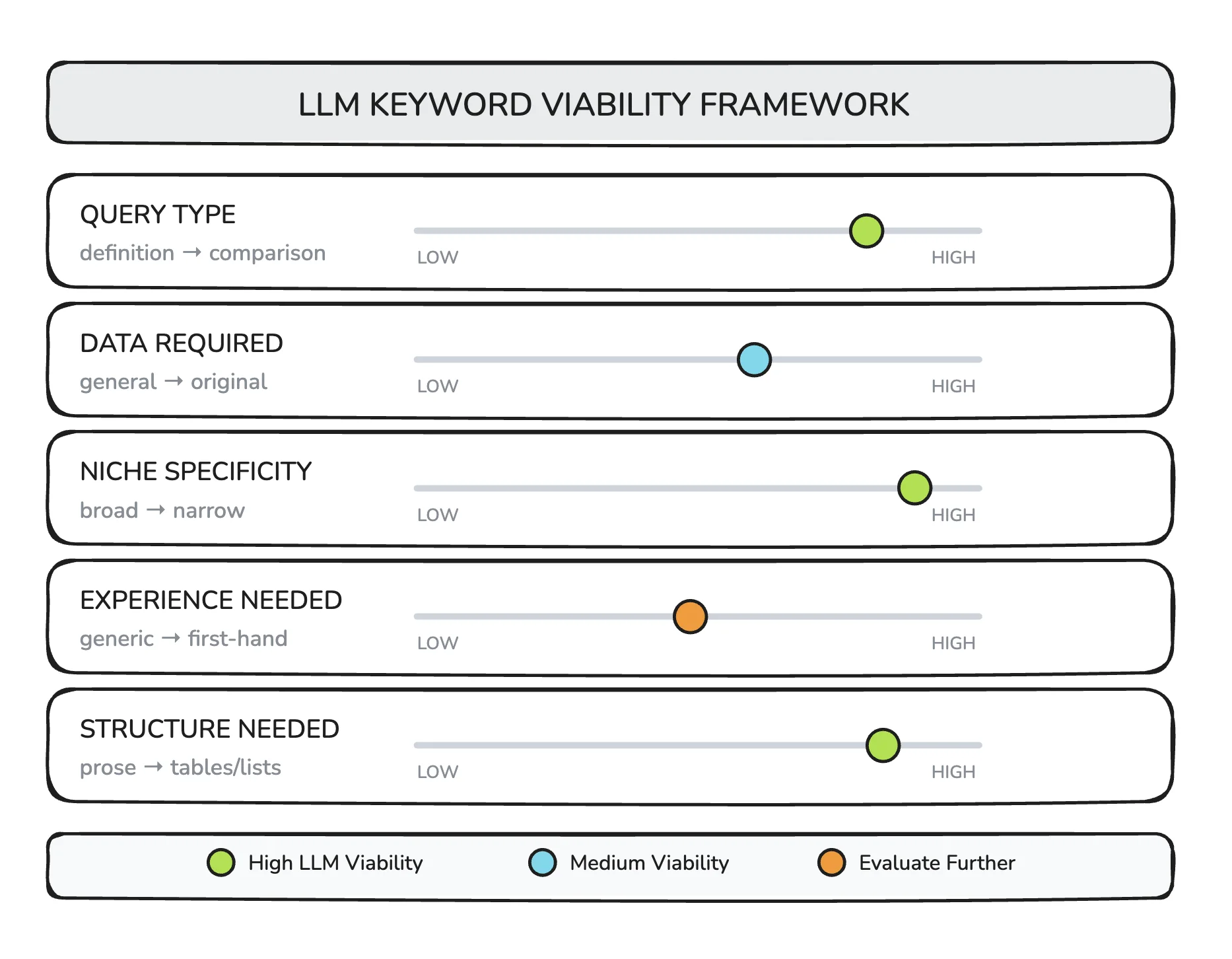
The LLM Keyword Viability Framework
Use this framework when evaluating any keyword:
| Factor | Low LLM Visibility | High LLM Visibility |
|---|---|---|
| Query type | Definitional, basic facts | Comparisons, current data, step-by-step |
| Data required | General knowledge | Specific, current, or original data |
| Niche specificity | Broad, common topics | Narrow, specialized topics |
| Experience needed | Generic advice works | First-hand proof required |
| Structure needed | Prose answers work | Tables, lists, specs needed |
Prioritize keywords that score "High" on multiple factors.
Entity-Based Keyword Research for AI Visibility
Traditional keyword research starts with seed keywords and expands to variations. LLM-focused keyword research starts with entities and builds topical authority.
Why? Because AI systems understand content through entities and relationships, not just keyword matching.
What Is Entity-Based Keyword Research?
An entity is a distinct, well-defined concept that can be unambiguously identified. In SEO terms:
- "BrightKeyword" is an entity (a specific tool)
- "Ahrefs" is an entity (a specific company)
- "Keyword clustering" is an entity (a specific concept)
- "SEO" is an entity (a specific discipline)
AI systems like Google's Knowledge Graph organize information by entities and their relationships. When your content clearly associates with recognized entities, AI is more likely to cite it as authoritative on that topic.
How to Find Entity-Focused Keywords
Step 1: Identify your core entity
What specific topic, product, or concept do you want to be known for?
For a keyword research tool like BrightKeyword, core entities might be:
- Keyword clustering
- Search intent analysis
- Long-tail keyword discovery
- Topic modeling
Step 2: Map related entities
Use tools to discover entities related to your core:
- Google's "People also ask" reveals related questions and concepts
- Wikipedia's internal links show how entities connect
- Knowledge Graph explorers reveal entity relationships
- BrightKeyword's semantic clustering groups related terms by entity
Step 3: Build keyword clusters around entities
Instead of a flat keyword list, create clusters where each cluster represents an entity you want to own. You can do this manually or use a tool like BrightKeyword that automatically organizes keywords into intent-based clusters:
| Entity Cluster | Keywords in Cluster |
|---|---|
| Keyword Clustering | keyword clustering tools, how to cluster keywords, keyword grouping, semantic keyword clustering, topic clusters SEO |
| Search Intent | search intent types, how to identify search intent, commercial vs informational intent, keyword intent analysis |
| Long-tail Keywords | long-tail keyword research, finding long-tail keywords, long-tail vs short-tail, low competition keywords |
Step 4: Create "definitive source" content for each entity
For each entity cluster, your goal is to create the content that AI systems will cite when asked about that topic. This means:
- Comprehensive coverage of the entity
- Original data, examples, or frameworks
- Clear structure with extractable information
- Internal linking between related entities
Entity Research in Practice
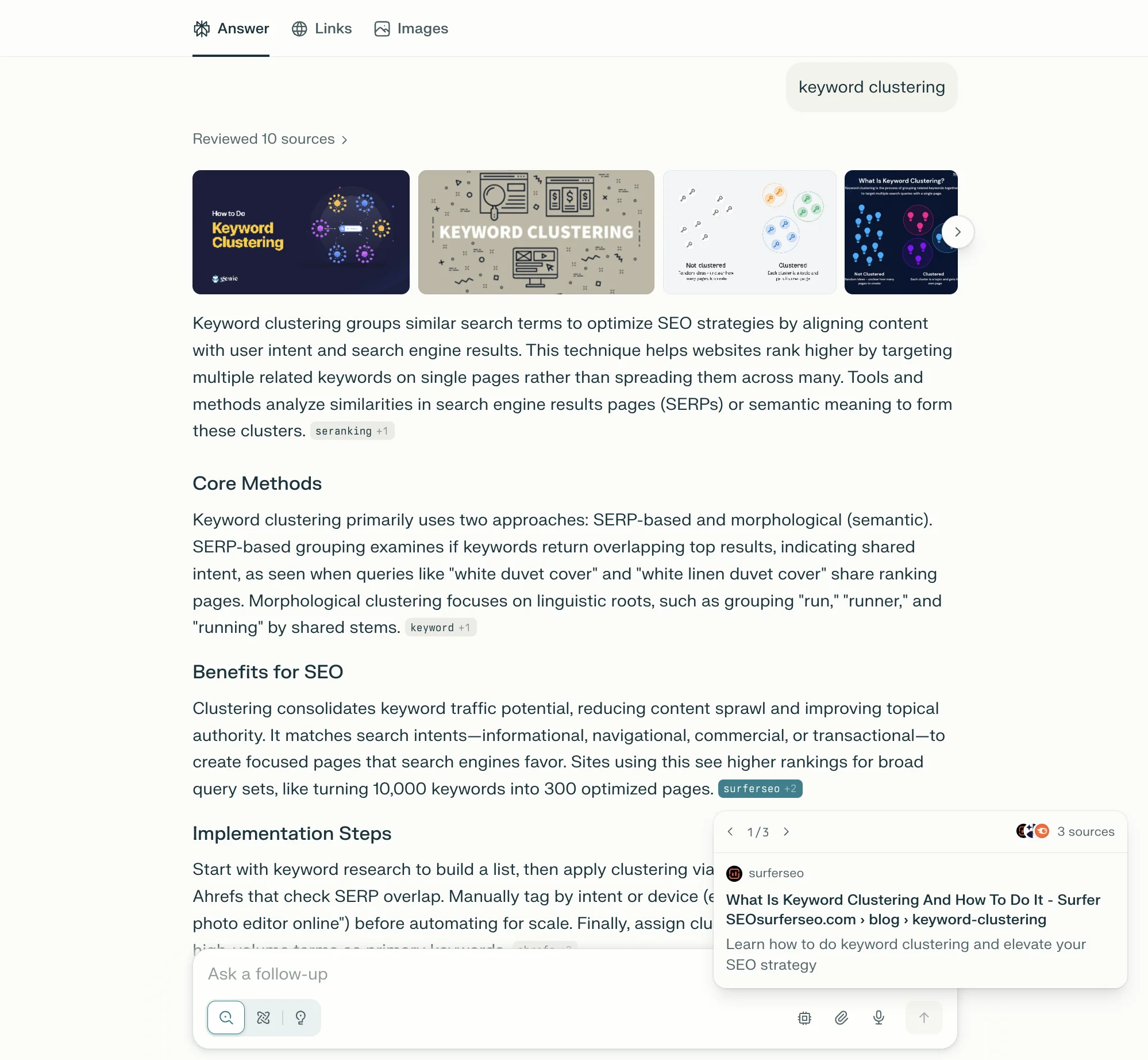
Here's how I approach entity-based keyword research for a topic like "keyword clustering":
- Search the entity in multiple AI systems (ChatGPT, Perplexity, Google AI Overview)
- Note which sources get cited for this topic
- Analyze what those sources have that makes them citable (data, structure, depth)
- Identify gaps where no source is comprehensive
- Build a keyword list around becoming the definitive source
If AI currently cites 3-4 mediocre sources for "keyword clustering," there's an opportunity to become THE source it cites by creating something more comprehensive and structured.
Topic Modeling: Finding Keywords AI Systems Connect
Topic modeling is the process of identifying groups of related keywords and concepts that form a complete topic. For LLM visibility, topic modeling helps you understand what a "complete" answer looks like to an AI system.
Why Topic Modeling Matters for LLMs
When AI generates a response about a topic, it synthesizes information from multiple angles. A query about "keyword research" might trigger the AI to cover:
- Definition and importance
- Process and methodology
- Tools and resources
- Common mistakes
- Advanced techniques
If your content only covers 2 of these 5 angles, you're unlikely to be cited as a comprehensive source. Topic modeling reveals the complete picture.
How to Use Topic Modeling for Keyword Research
Method 1: Analyze AI responses directly
Ask ChatGPT or Perplexity a broad question about your topic. Analyze the structure of the response:
- What subtopics does it cover?
- What questions does it answer?
- What examples does it use?
These reveal the "shape" of a complete topic from an AI perspective.
Method 2: Use semantic clustering tools
Semantic clustering tools automatically group keywords by meaning rather than exact match. BrightKeyword does this by analyzing search intent and semantic relationships, organizing your keyword list into clusters that map to content opportunities. This reveals:
- Which keywords belong to the same topic
- What subtopics exist within a broader topic
- Gaps in your current content coverage
Method 3: Analyze "People Also Ask" comprehensively
For any seed keyword, extract all "People Also Ask" questions. Group them by theme. Each theme is a subtopic you should cover for comprehensive LLM visibility.
From Topic Model to Content Plan
Once you've mapped a topic, translate it to content:
| Topic: Keyword Research | Subtopic | Content Needed | LLM Citation Potential |
|---|---|---|---|
| Definition | What is keyword research | Low (AI answers without sources) | |
| Process | Step-by-step keyword research guide | Medium (needs specificity) | |
| Tools | Best keyword research tools | High (comparisons need sources) | |
| For specific use cases | Keyword research for SaaS / e-commerce / local | High (niche = more citations) | |
| Mistakes | Common keyword research mistakes | High (experience-based) | |
| Advanced | Keyword clustering, content calendars | High (specialized concepts) |
Focus your keyword research on the high-potential subtopics.
Finding Keywords That Require Structured Answers
AI systems extract and cite structured content more easily than flowing prose. Keywords that naturally require structured answers have higher LLM citation potential.
What Makes Content "Structured" for AI
AI can easily extract and cite:
- Comparison tables with clear rows and columns
- Numbered step-by-step processes
- Pros and cons lists
- Specifications and feature lists
- Definitions followed by examples
- Decision frameworks (if X, then Y)
AI struggles to cite:
- Long paragraphs of analysis
- Conversational content without clear structure
- Opinion pieces without supporting data
- Content that requires reading the full context
Keywords That Demand Structured Answers
Look for keywords with these patterns:
| Keyword Pattern | Why It's Structured | Example |
|---|---|---|
| "X vs Y" | Requires comparison table | "Ahrefs vs Semrush" |
| "Best X for Y" | Requires ranked list with criteria | "Best keyword tools for beginners" |
| "How to X step by step" | Requires numbered process | "How to do keyword research step by step" |
| "X checklist" | Requires checkbox list | "SEO audit checklist" |
| "X template" | Requires downloadable framework | "Keyword research template" |
| "Types of X" | Requires categorized list | "Types of search intent" |
| "X pricing" or "X cost" | Requires pricing table | "Ahrefs pricing 2025" |
These keywords signal that users expect structured content. So does AI.
How to Find Structured-Answer Keywords
Use keyword modifiers as filters:
When researching keywords, filter for terms containing:
- "vs" or "versus"
- "best"
- "top" + number
- "checklist"
- "template"
- "step by step"
- "types of"
- "examples"
- "pricing" or "cost"
- "comparison"
- "list"
These modifiers indicate the searcher expects structured, extractable content.
Check if Google shows structured results:
Search the keyword and look for:
- Featured snippets with lists or tables
- "People Also Ask" boxes
- Knowledge panels
If Google displays structured SERP features, AI systems also expect structured answers. This is your signal to create structured content that can be cited.
Evaluating Keyword Viability in the AI Era
Before committing to any keyword, run it through an AI-era viability assessment. Not every keyword that looks good in traditional metrics will deliver value as AI search grows.
The 5-Question LLM Keyword Assessment
For each keyword you're considering, ask:
1. Does AI already answer this completely without sources?
Test it: Enter the query into ChatGPT and Perplexity. Does the response cite sources, or does it answer confidently from general knowledge?
- If sources are cited → Good LLM potential
- If answered without sources → Low LLM potential
2. Will ranking still deliver clicks in 12 months?
Consider: Is this the type of query Google is showing AI Overviews for? Are zero-click behaviors increasing for this topic?
- Transactional/commercial queries → Still click-resilient
- Informational definitions → Clicks likely to decline
3. Can you add something AI cannot fabricate?
Ask: Do you have original data, case studies, screenshots, or first-hand experience? Can you create comparison tables with real testing?
- Original, provable content → Citable by AI
- Aggregated generic advice → Not citable
4. Does this keyword align with an entity you want to own?
Consider: Is this keyword part of a topic cluster you're building authority in? Does it connect to other content on your site?
- Part of a topical cluster → Builds entity authority
- Random one-off keyword → Limited long-term value
5. Does the keyword require structured content to answer well?
Check: Do top-ranking pages use tables, lists, and step-by-step formats? Does the query pattern suggest structured expectations?
- Structured format expected → Higher citation potential
- Prose/essay expected → Lower citation potential
Keyword Scoring Template
Score each keyword 1-5 on each factor:
| Keyword | AI Cites Sources? | Click Resilience | Original Content Possible? | Entity Alignment | Structure Needed? | Total |
|---|---|---|---|---|---|---|
| [keyword 1] | /5 | /5 | /5 | /5 | /5 | /25 |
| [keyword 2] | /5 | /5 | /5 | /5 | /5 | /25 |
Prioritize keywords scoring 18+ out of 25.
Practical Workflow: LLM Keyword Research Step by Step
Here's the complete workflow for finding keywords with high LLM visibility potential:
Step 1: Define Your Entity Territory
Before researching keywords, define:
- Primary entity: What specific topic do you want to be THE source for?
- Related entities: What connected concepts support your primary entity?
- Entity gaps: What topics do competitors cover that you don't?
Step 2: Generate Initial Keyword List
Use a combination of:
- Seed keyword expansion (traditional approach)
- AI brainstorming (using ChatGPT for keyword ideas)
- Competitor analysis (what entities do they cover?)
- Semantic discovery tools (BrightKeyword generates keywords organized by intent clusters, which maps well to entity-based research)
Aim for 100+ initial keywords.
Step 3: Cluster by Entity and Intent
Group keywords into clusters based on:
- Entity: Which specific concept does this keyword relate to?
- Intent: Is this informational, commercial, transactional?
- Content type: Does this need a guide, comparison, list, or tool?
Each cluster should map to a potential piece of content.
Step 4: Filter by LLM Viability
For each cluster, evaluate:
- Does AI cite sources for these queries? (Test in ChatGPT/Perplexity)
- Can you create structured, original content?
- Does this align with your entity strategy?
Remove clusters with low LLM potential.
Step 5: Prioritize by Opportunity
Rank remaining clusters by:
- Search volume (still matters for discovery)
- Competition (can you realistically rank?)
- LLM citation potential (will AI cite you?)
- Business value (does this drive conversions?)
Step 6: Plan Content That Gets Cited
For each priority cluster, plan content that:
- Answers comprehensively (covers all subtopics)
- Includes structured elements (tables, lists, steps)
- Adds original value (data, examples, experience)
- Links to related entities (internal linking to your other content)
Frequently Asked Questions
What is LLM SEO?
LLM SEO (Large Language Model SEO) is the practice of optimizing content to be cited, referenced, or surfaced by AI systems like ChatGPT, Perplexity, Claude, and Google's AI Overviews. Unlike traditional SEO which focuses on ranking positions, LLM SEO focuses on becoming a trusted source that AI cites when generating answers.
How do I know if AI is citing my content?
Currently, tools for tracking AI citations are limited. Manual methods include:
- Searching your topic in Perplexity and checking if your site appears in citations
- Asking ChatGPT questions in your niche and seeing if it references your content
- Monitoring referral traffic from AI platforms in your analytics
New tools for AI visibility tracking are emerging, but the market is still developing.
Does traditional keyword research still matter?
Yes. Traditional SEO and LLM SEO are complementary. You still need to rank in Google for AI systems to find and cite your content. The difference is that you should prioritize keywords where ranking will also lead to AI citations, not just clicks.
Should I stop targeting informational keywords?
Not entirely, but be strategic. For pure definitional queries ("What is SEO?"), AI answers without sources, so your LLM visibility is low. For complex informational queries requiring data, examples, or step-by-step processes, AI often cites sources. Focus on the latter.
How is this different from regular AI search optimization?
This guide focuses on the keyword research aspect of AI visibility. The complementary piece, keyword research for AI search, covers how to adapt when AI Overviews reduce clicks. This guide is about finding keywords where you can become a cited source.
The Future Belongs to Cited Sources
Here's the uncomfortable truth: You can rank #1 on Google and still be invisible in AI search.
The keywords worth targeting have changed. The content formats that win have shifted. The metrics that matter are different.
But here's the opportunity: Most SEOs are still doing keyword research the old way. They're chasing volume and rankings without asking whether AI will cite their content.
The ones who adapt their keyword research for LLM visibility will own the next era of search.
Start by auditing your current keyword targets. Test them in ChatGPT and Perplexity. Ask: "If I rank for this, will AI cite me as a source?"
If the answer is no, find better keywords.
The game has changed. Now you know how to play it.