
Competitor SEO Analysis: How to Find Keyword and Content Gaps Your Rivals Miss
Your competitors are ranking for keywords you've never even considered. They're capturing traffic you should be getting. And every day you don't know what they're doing, you fall further behind.
Most SEO teams run competitor analysis once, dump the data into a spreadsheet, and never look at it again. They identify a few obvious keywords, add them to their content calendar, and call it done. That's not analysis. That's box-checking.
Real competitor SEO analysis is systematic intelligence gathering. You're not just finding keywords they rank for. You're discovering the gaps in their strategy, the topics they've neglected, and the opportunities they've left on the table. Then you take them.
In this guide, you'll learn how to conduct competitor analysis that actually drives results. We'll cover keyword gap analysis, content gap identification, backlink opportunities, and how to turn competitive intelligence into a prioritized action plan. You'll walk away knowing exactly where to attack and what to ignore.
Your competitors did the hard work of validating what ranks. Now use it against them.

What Is Competitor SEO Analysis (And Why Most People Do It Wrong)
Competitor SEO analysis is the process of systematically studying your competitors' organic search performance to find opportunities for your own site. You examine their rankings, content, backlinks, and technical setup to understand what's working for them and where they're vulnerable.
The goal isn't to copy competitors. It's to learn from their successes and exploit their failures.
Why Traditional Competitor Analysis Fails
I've seen teams spend weeks building massive competitor keyword spreadsheets. Thousands of rows. Every keyword their competitors rank for. Then nothing happens. The spreadsheet sits in Google Drive, unopened, while the team goes back to guessing what to write about.
Here's what goes wrong:
Data without prioritization. Knowing a competitor ranks for 50,000 keywords is useless without a framework for deciding which ones matter to you.
Copying instead of differentiating. If you just write the same content your competitor has, you're fighting for the same pie. Smart analysis finds the slices they missed.
One-time analysis. Competitor positions change. New content gets published. A snapshot from six months ago tells you nothing about today's opportunities.
Ignoring intent. A competitor might rank for keywords completely irrelevant to their business. Ranking for "free templates" when you sell enterprise software isn't a gap worth filling.
What Good Competitor Analysis Looks Like
Effective competitor SEO analysis answers specific questions:
| Question | What It Reveals |
|---|---|
| What keywords do they rank for that I don't? | Keyword gaps to target |
| What topics have they covered that I haven't? | Content gaps to fill |
| Where are they ranking poorly despite targeting? | Weaknesses to exploit |
| Who links to them but not me? | Backlink opportunities |
| What's their content strategy pattern? | Publishing cadence and priorities |
The output isn't a spreadsheet. It's a prioritized list of actions with expected impact.
Step 1: Identify Your True SEO Competitors
Your SEO competitors aren't always your business competitors. A SaaS company selling project management software might compete with Monday.com for customers but compete with HubSpot, Asana's blog, and random productivity websites for search rankings.
Finding Your Organic Competitors
Start with your target keywords, not your industry.
Method 1: Search your core keywords manually
Search 10-15 of your most important keywords. Note which domains appear repeatedly in the top 10. These are your organic competitors.
Method 2: Use competitive analysis tools
Tools like Ahrefs, Semrush, or Sistrix have "organic competitors" reports. Enter your domain, and they'll show sites that rank for similar keywords.
| Tool | Report Name | What It Shows |
|---|---|---|
| Ahrefs | Organic Competitors | Sites ranking for same keywords, sorted by overlap |
| Semrush | Organic Research → Competitors | Traffic share and keyword overlap percentages |
| Sistrix | Competitors | Visibility overlap and competition strength |
Method 3: Check who ranks for your money keywords
Your "money keywords" are the ones that drive conversions, not just traffic. Check who consistently appears for these terms. They're your primary competitors regardless of what other keywords they target.
Segmenting Competitors
Not all competitors deserve equal attention. Segment them:
Direct competitors (primary): Same business model, same target keywords, fighting for the same customers. Give them 50% of your analysis time.
Content competitors (secondary): Different business but ranking for your target keywords. Media sites, blogs, directories. Give them 30% of your analysis time.
Aspirational competitors (tertiary): Industry leaders you want to eventually compete with. Study their strategy for long-term planning. Give them 20% of your analysis time.
Pick 3-5 primary competitors for deep analysis. Going wider spreads your focus too thin.
Step 2: Keyword Gap Analysis (Finding What You're Missing)
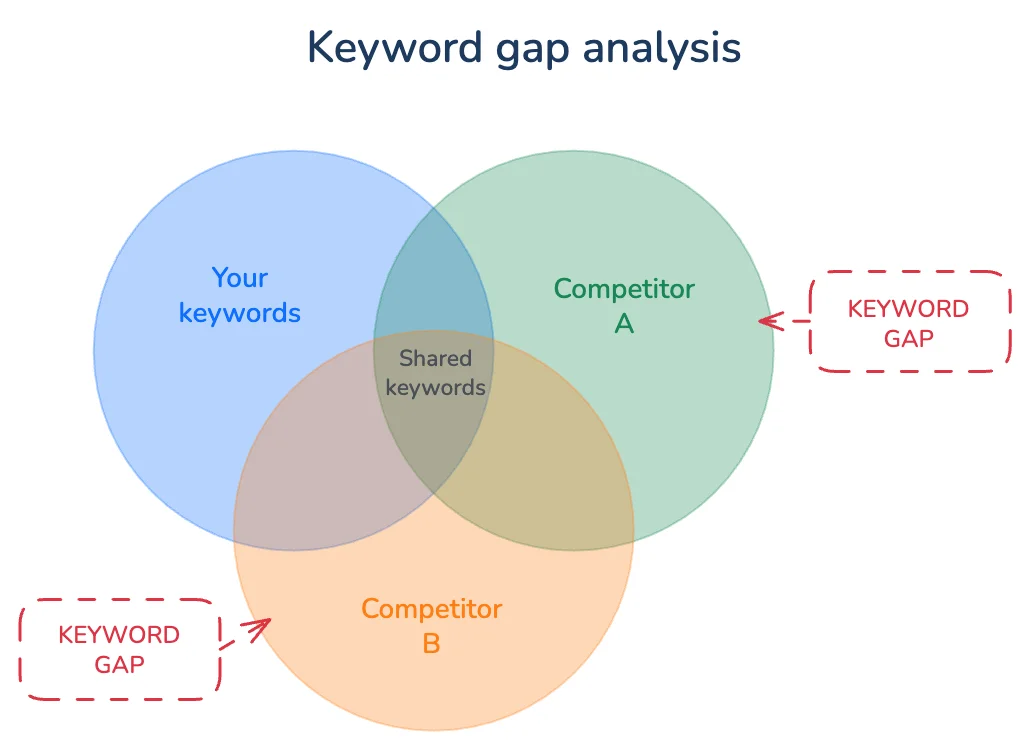
Keyword gap analysis compares your keyword rankings against competitors to find terms they rank for that you don't. These gaps represent immediate opportunities because someone has already proven the keyword drives traffic.
Running a Keyword Gap Analysis
Most SEO tools have a dedicated "keyword gap" or "content gap" feature. Here's the process:
Step 1: Enter your domain and 2-4 competitor domains
Use your primary competitors identified in Step 1.
Step 2: Filter for keywords where competitors rank but you don't
Look for keywords where at least one competitor ranks in the top 20, and you either don't rank at all or rank beyond position 50.
Step 3: Filter by relevance and intent
Remove keywords that:
- Don't match your business (branded competitor terms, unrelated products)
- Have purely navigational intent (searching for a specific site)
- Target audiences you don't serve
Step 4: Sort by opportunity
Prioritize by search volume, keyword difficulty, and business relevance. A high-volume, low-difficulty keyword that matches buyer intent is gold.
Interpreting Gap Analysis Results
Not every gap is worth pursuing. Categorize what you find:
| Gap Type | Example | Action |
|---|---|---|
| Quick wins | High volume, low difficulty, you have a relevant page | Optimize existing page for this keyword |
| Content opportunities | Medium volume, competitors have dedicated content, you don't | Create new content targeting this topic |
| Strategic gaps | High volume, high difficulty, important to your business | Add to long-term content roadmap |
| Ignore | Low volume, off-topic, or low intent | Skip entirely |
Example Keyword Gap Analysis
Let's say you run a B2B marketing automation platform. You analyze three competitors and find:
Keyword Gap Results (simplified example):

Keyword                           | Volume | Your Rank | Comp A | Comp B | Comp C
----------------------------------|--------|-----------|--------|--------|-------
email marketing automation        | 8,100  | -         | 3      | 7      | 12
lead scoring best practices       | 1,900  | -         | 5      | -      | 8
marketing automation for startups | 720    | -         | -      | 4      | 6
drip campaign examples            | 2,400  | 45        | 2      | 3      | -
From this data:
- "email marketing automation" is a strategic gap (high volume, all competitors rank, you don't)
- "lead scoring best practices" is a content opportunity (medium volume, two competitors rank well)
- "drip campaign examples" is a quick win (you rank poorly, competitors rank well, likely fixable with optimization)
How to Find Competitor Keywords Without Expensive Tools
Not everyone has Ahrefs or Semrush budgets. Here are alternatives:
Google Search Console comparison: Export your GSC queries. Then manually search competitor pages and note what keywords they target in titles, H1s, and meta descriptions. Compare the lists.
Free tools with limitations: Ubersuggest, SE Ranking's free tier, and Moz's free tools offer limited competitor analysis.
Manual SERP analysis: Search your target keywords, note who ranks, then explore their sites to find related content you haven't covered. Time-intensive but free.
For a more automated approach to pulling and analyzing this data, see our guide on Python SEO automation which covers building scripts to gather competitive intelligence.
Step 3: Content Gap Analysis (Finding Topics, Not Just Keywords)
Content gap analysis goes beyond individual keywords to examine topics and content types. A competitor might rank for 50 keywords all pointing to a single comprehensive guide you don't have. That's a content gap, not 50 keyword gaps.
Content Gaps vs. Keyword Gaps
| Analysis Type | Focus | Output |
|---|---|---|
| Keyword gap | Individual search terms | List of keywords to target |
| Content gap | Topics, formats, content types | Content pieces to create |
Both matter. Keyword gaps help you optimize. Content gaps help you build.
How to Find Content Gaps
Method 1: Analyze competitor site structure
Visit each competitor's blog or resource section. List every topic category they cover. Compare to yours.
Competitor A Topics:        Your Topics:           Gap:
- Email Marketing           - Email Marketing
- Lead Generation           - Lead Generation
- Marketing Automation      - Marketing Automation
- Sales Enablement          -                       ← Gap
- Customer Success          -                       ← Gap
- ABM Strategy              - ABM Strategy
- Revenue Operations        -                       ← Gap
Those gaps aren't individual keywords. They're entire content pillars you're missing.
Method 2: Content type analysis
Competitors might have content formats you don't:
- Comparison pages ("Tool A vs Tool B")
- Templates and downloadable resources
- Case studies with specific results
- Industry reports and original research
- Video content or webinars
- Glossary or definition pages
If a competitor ranks well with "marketing automation templates" and you don't offer templates, that's a content type gap.
Method 3: Topical depth comparison
For topics you both cover, compare depth. If your competitor has:
- A pillar page on "email marketing"
- 15 supporting articles on subtopics
- Internal links connecting them all
And you have:
- One blog post on "email marketing basics"
You have a topical depth gap, not a content gap. You need to build out the topic cluster, not just add one article.
Prioritizing Content Gaps
Use this framework to decide which gaps to fill first:
| Priority Score | Business Value | Search Volume | Competition | Score |
|---|---|---|---|---|
| High (fill now) | Core to business | 1000+ monthly | You can compete | 8-10 |
| Medium (next quarter) | Related to business | 500-999 monthly | Moderate competition | 5-7 |
| Low (backlog) | Tangential | Under 500 monthly | High competition | 1-4 |
Score each gap on these factors. Fill high-priority gaps first.
Turning Content Gaps Into Your Content Calendar
Once you've identified gaps, map them to your publishing schedule. For guidance on building an effective content calendar from keyword research, see our guide on from keywords to content calendar.
Step 4: Backlink Gap Analysis (Finding Link Opportunities)
If someone links to your competitor but not you, they're a potential link opportunity. Backlink gap analysis identifies these sites so you can pursue similar links.
How Backlink Gap Analysis Works
Step 1: Pull competitor backlink profiles
Use Ahrefs, Semrush, Moz, or Majestic to export backlinks for each competitor.
Step 2: Compare against your backlinks
Most tools have a "link intersect" feature. Enter your domain and competitors. The tool shows domains that link to competitors but not you.
Step 3: Filter for quality
Not every linking domain is worth pursuing. Filter for:
- Domain Rating/Authority above 30
- Relevant to your industry
- Actually active (not abandoned sites)
- Editorial links (not spam directories)
Step 4: Categorize opportunities
| Link Type | Example | Outreach Approach |
|---|---|---|
| Resource pages | "Best marketing tools" lists | Pitch your tool for inclusion |
| Guest post sites | Sites that accepted competitor guest posts | Pitch your own guest post |
| Broken links | Links to competitor content that's now 404 | Offer your content as replacement |
| Mentions without links | Competitor mentioned but not linked | May work for you too |
| Industry directories | Niche directories listing competitors | Submit your site |
Realistic Expectations for Link Gap Outreach
Not every site that links to competitors will link to you. Expect:
- 5-15% response rate on cold outreach
- 1-5% conversion to actual links
- Higher success with genuine relationship building
Prioritize quality over quantity. Ten links from relevant, authoritative sites beat 100 links from random blogs.
Analyzing Why Competitors Get Links
Beyond finding who links to them, understand why:
Content that earns links:
- Original research and data
- Comprehensive guides (linkable assets)
- Free tools and calculators
- Controversial or unique takes
- Visual assets (infographics, diagrams)
If competitors earn links from original research and you only publish opinion pieces, your link gap stems from a content format gap. Fix the root cause.
Competitor Analysis Tools: What to Use
Different tools excel at different aspects of competitor analysis. Here's an honest comparison:
| Tool | Best For | Keyword Gap | Content Gap | Backlink Gap | Price |
|---|---|---|---|---|---|
| Ahrefs | Backlink analysis, comprehensive data | ✓ Strong | ✓ Good | ✓ Excellent | $99+/mo |
| Semrush | All-in-one SEO, advertising data | ✓ Excellent | ✓ Excellent | ✓ Good | $129+/mo |
| Moz Pro | Beginner-friendly, US focus | ✓ Good | ✓ Basic | ✓ Good | $99+/mo |
| Sistrix | European markets, visibility index | ✓ Good | ✓ Good | ✓ Basic | €99+/mo |
| SpyFu | PPC competitor data | ✓ Good | ✓ Basic | ✗ Limited | $39+/mo |
| Ubersuggest | Budget-friendly starting point | ✓ Basic | ✓ Basic | ✓ Basic | Free-$40/mo |
My recommendation: If budget allows, Ahrefs or Semrush. If budget is tight, Ubersuggest or Moz's free tools combined with manual analysis.
Free Methods That Actually Work
You don't need expensive tools for basic competitor analysis:
Google Search Console: Your own data is free. Compare your keyword performance against what you see competitors targeting in SERPs.
Google Alerts: Set alerts for competitor brand names to track their new content and mentions.
SimilarWeb (free tier): Basic traffic estimates and traffic source breakdowns for competitors.
Manual SERP analysis: Time-intensive but reveals exactly what Google rewards for your target keywords.
For pulling and analyzing data at scale without enterprise tool costs, you can build your own scripts. Our Python SEO automation guide covers connecting to APIs and processing competitive data.
Building a Competitive Intelligence Framework
One-time competitor analysis decays quickly. Rankings change. New content gets published. Competitors pivot strategies. You need an ongoing framework, not a quarterly project.
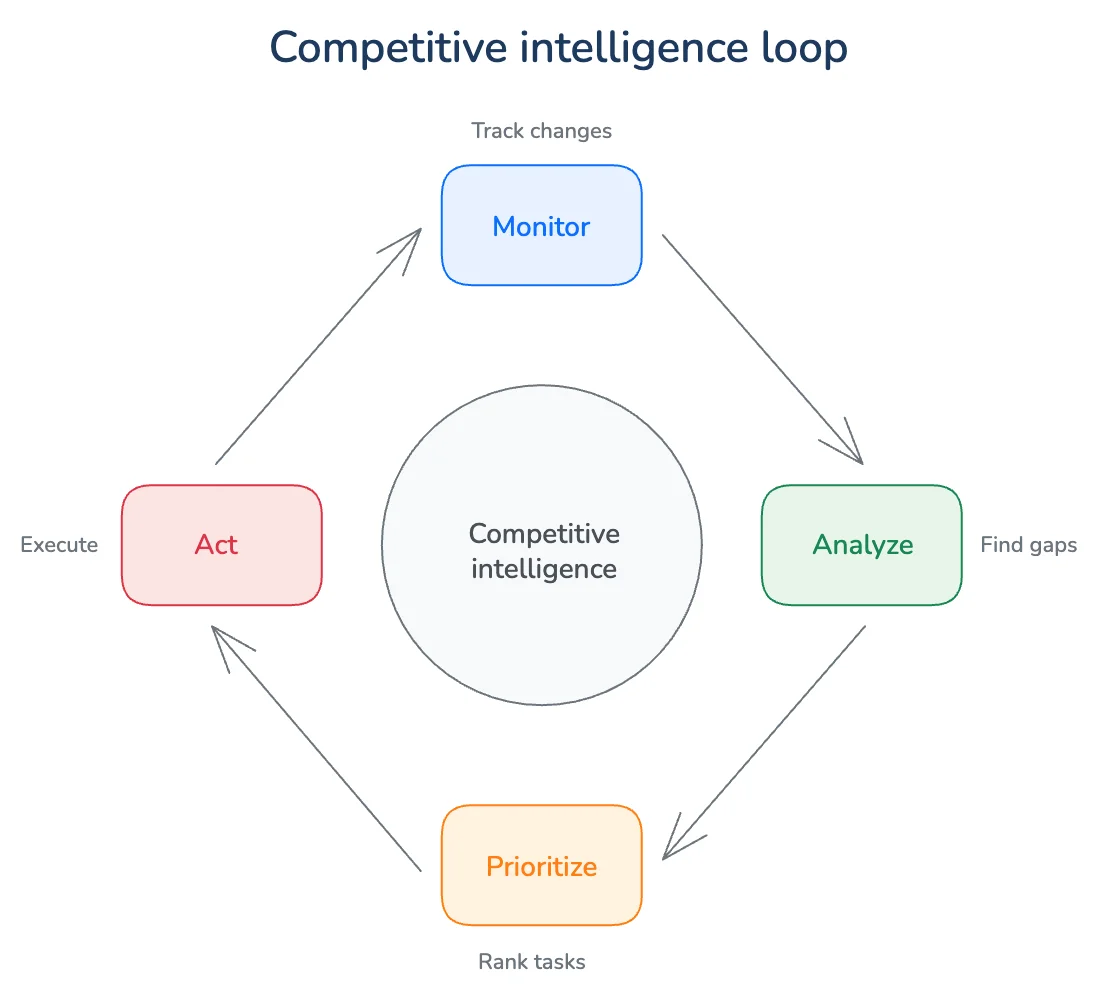
Weekly Monitoring (30 minutes)
Track these metrics weekly:
- Rank changes: Are competitors gaining or losing on your key terms?
- New content: What did they publish this week?
- SERP feature changes: Did they win or lose featured snippets?
Set up automated alerts where possible. Google Alerts for brand mentions. Rank tracking tools for position changes. RSS feeds for competitor blogs.
Monthly Analysis (2-3 hours)
Each month, conduct a focused analysis:
- Keyword movement: Which gaps opened or closed?
- Content performance: Which competitor content gained traction?
- Link acquisition: Who earned new notable links?
- Strategy shifts: Any new content types or topics emerging?
Document findings in a shared document. Look for patterns over time.
Quarterly Deep Dive (1 day)
Full competitive analysis refresh:
- Re-run keyword gap analysis
- Update content gap assessment
- Full backlink profile comparison
- Competitive positioning review
Use this to inform next quarter's content and SEO priorities.
What to Track in Your Competitive Dashboard
| Metric | Frequency | Tool/Method |
|---|---|---|
| Ranking for top 50 keywords | Weekly | Rank tracker |
| Competitor new content | Weekly | RSS/manual check |
| Competitor backlink growth | Monthly | Ahrefs/Semrush |
| Keyword overlap changes | Monthly | Gap analysis tool |
| SERP feature ownership | Monthly | Rank tracker |
| Estimated traffic comparison | Quarterly | Semrush/SimilarWeb |
Turning Analysis Into Action: Prioritization Framework
Data means nothing without action. Here's how to convert competitive intelligence into prioritized tasks.
The Impact-Effort Matrix for Competitor Opportunities
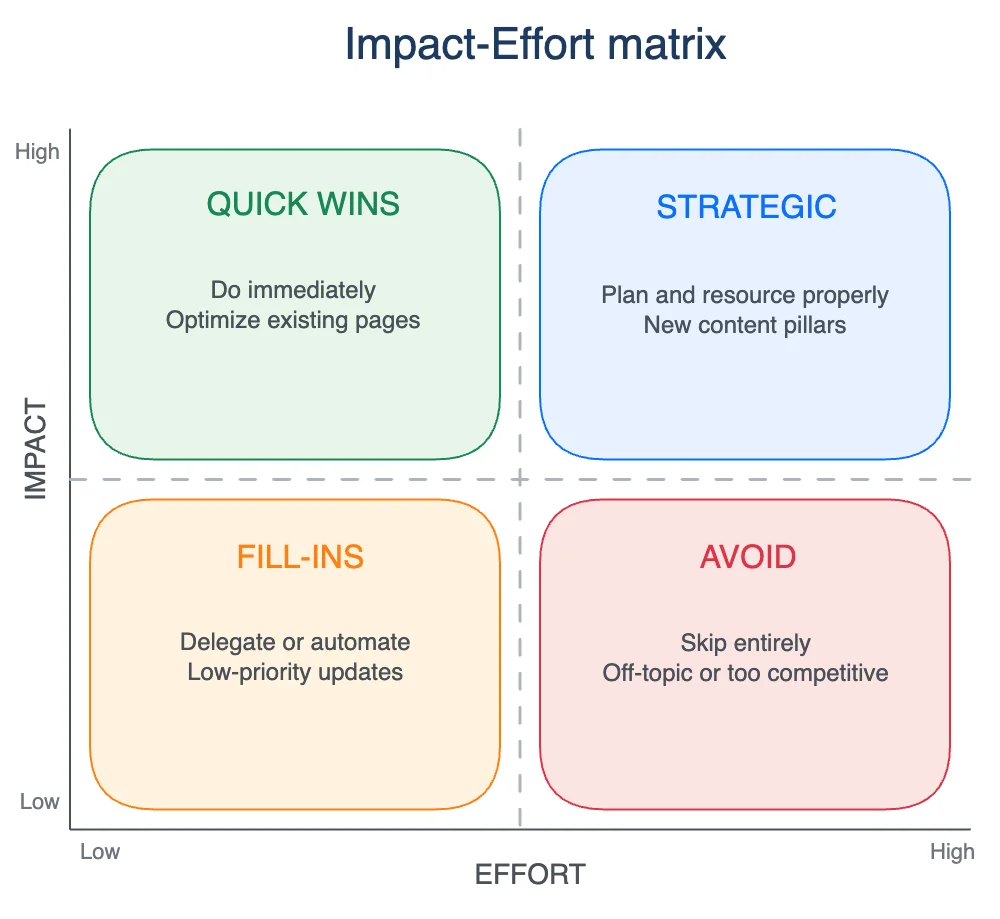
Plot each opportunity on two axes:
- Impact: How much traffic/revenue could this drive?
- Effort: How much time/resources to capture this opportunity?
| Quadrant | Impact | Effort | Action |
|---|---|---|---|
| Quick wins | High | Low | Do immediately |
| Strategic projects | High | High | Plan and resource properly |
| Fill-ins | Low | Low | Delegate or automate |
| Avoid | Low | High | Skip entirely |
Prioritization Criteria
Score each competitive opportunity:
Opportunity Score = (Search Volume × Intent Match × Win Probability) / Effort

Where:
- Search Volume: Monthly searches (normalized 1-10)
- Intent Match: How well it matches your business (1-10)
- Win Probability: Can you realistically outrank? (1-10)
- Effort: Resources required (1-10, higher = more effort)
A keyword with 5,000 searches, perfect intent match, reasonable competition, and moderate effort scores higher than a keyword with 50,000 searches, poor intent match, and brutal competition.
Sample Action Plan From Competitor Analysis
Here's what a prioritized action plan might look like:
This Week (Quick Wins):
1. Optimize existing "email marketing guide" for "email marketing automation" keyword gap
2. Add comparison table to "marketing tools" page (competitor has one, we don't)
3. Submit to 3 industry directories where competitors are listed
This Month (Content Opportunities):
1. Create "lead scoring best practices" guide (content gap, medium volume)
2. Build "marketing automation templates" resource (content type gap)
3. Reach out to 10 sites for backlink gap opportunities
This Quarter (Strategic Projects):
1. Develop "Revenue Operations" content pillar (major topic gap)
2. Create original research report for link building
3. Build comparison pages for top 5 competitor tools
Common Mistakes in Competitor SEO Analysis
I've made these mistakes. I've watched teams make them. Avoid them.
Mistake 1: Chasing Every Gap
Not every keyword your competitor ranks for deserves your attention. If they rank for "free CRM" and you sell enterprise software at $50,000/year, that's not a gap worth filling. Filter ruthlessly.
Mistake 2: Copying Instead of Differentiating
Creating the same content as competitors doesn't give searchers a reason to choose you. If they have a "Complete Guide to X," don't write another "Complete Guide to X." Write "The Practical Guide to X (No Fluff)" or "X for [Your Specific Audience]."
Mistake 3: Ignoring Search Intent
A competitor might rank for a keyword with content that poorly matches intent. Check what Google actually rewards. If the SERP is all comparison pages and your competitor ranks with a product page, the opportunity might be better than it looks.
Mistake 4: Overvaluing Volume, Undervaluing Intent
A 500-volume keyword with buyer intent can be worth more than a 5,000-volume keyword with informational intent. Analyze what keywords actually drive conversions, not just traffic. This is especially important for B2B keyword research where volume is typically lower but intent is higher.
Mistake 5: Analysis Paralysis
Some teams spend months analyzing competitors and never execute. Set a time limit. Make decisions with imperfect information. You can always adjust as you learn.
Frequently Asked Questions
How do I find competitor keywords?
Use SEO tools like Ahrefs, Semrush, or Moz to run a "keyword gap" or "content gap" analysis. Enter your domain and competitor domains. The tool shows keywords they rank for that you don't. Filter by relevance, volume, and difficulty to prioritize opportunities. For free alternatives, manually analyze competitor pages to identify target keywords from their titles, headings, and meta descriptions.
What is a keyword gap?
A keyword gap is a search term that your competitors rank for but you don't. Identifying keyword gaps reveals opportunities where competitors have validated that traffic exists. You can then create or optimize content to capture that traffic. Keyword gap analysis is foundational to competitive SEO because it shows proven opportunities rather than theoretical ones.
What is a content gap?
A content gap is a topic, content type, or content format that competitors cover but you don't. Unlike keyword gaps (individual search terms), content gaps represent entire pieces of content you're missing. For example, if competitors have comparison pages, case studies, or template libraries that you don't, those are content gaps. Filling content gaps often addresses multiple keyword gaps simultaneously.
How often should I run competitor analysis?
Run lightweight monitoring weekly (30 minutes checking rank changes and new competitor content). Conduct monthly focused analysis (2-3 hours on keyword and content shifts). Do a full competitive deep dive quarterly (one day reassessing all gaps and priorities). The market moves continuously, so one-time analysis becomes outdated within weeks.
Which competitor analysis tool is best?
For comprehensive analysis, Ahrefs or Semrush are industry standards. Ahrefs excels at backlink analysis. Semrush offers more all-in-one features including advertising data. For budget-conscious teams, Ubersuggest or Moz's free tier combined with manual SERP analysis works. The best tool is one you'll actually use consistently.
How many competitors should I analyze?
Focus on 3-5 primary competitors for deep analysis. These should be direct organic competitors (sites ranking for your target keywords), not just business competitors. You can monitor more competitors loosely, but spreading analysis across too many dilutes your focus and makes prioritization harder.
Stop Researching. Start Outranking.
Your competitors have spent years building their organic presence. They've tested what works. They've invested in content that ranks. And they've left gaps you can exploit.
The analysis framework in this guide gives you everything you need:
- Identify true competitors based on organic overlap, not just business rivalry
- Find keyword gaps where they rank and you don't
- Discover content gaps in topics and formats you're missing
- Uncover backlink opportunities from sites that link to them but not you
- Prioritize ruthlessly using impact-effort analysis
- Execute continuously with weekly, monthly, and quarterly rhythms
Most teams stop at step 2. They export a list of keywords and feel productive. But that list is worthless without steps 3-6. Analysis without action is just procrastination with spreadsheets.
The competitors who are outranking you right now started somewhere. They found opportunities, prioritized them, and executed. Now it's your turn.
What gap will you fill first?